
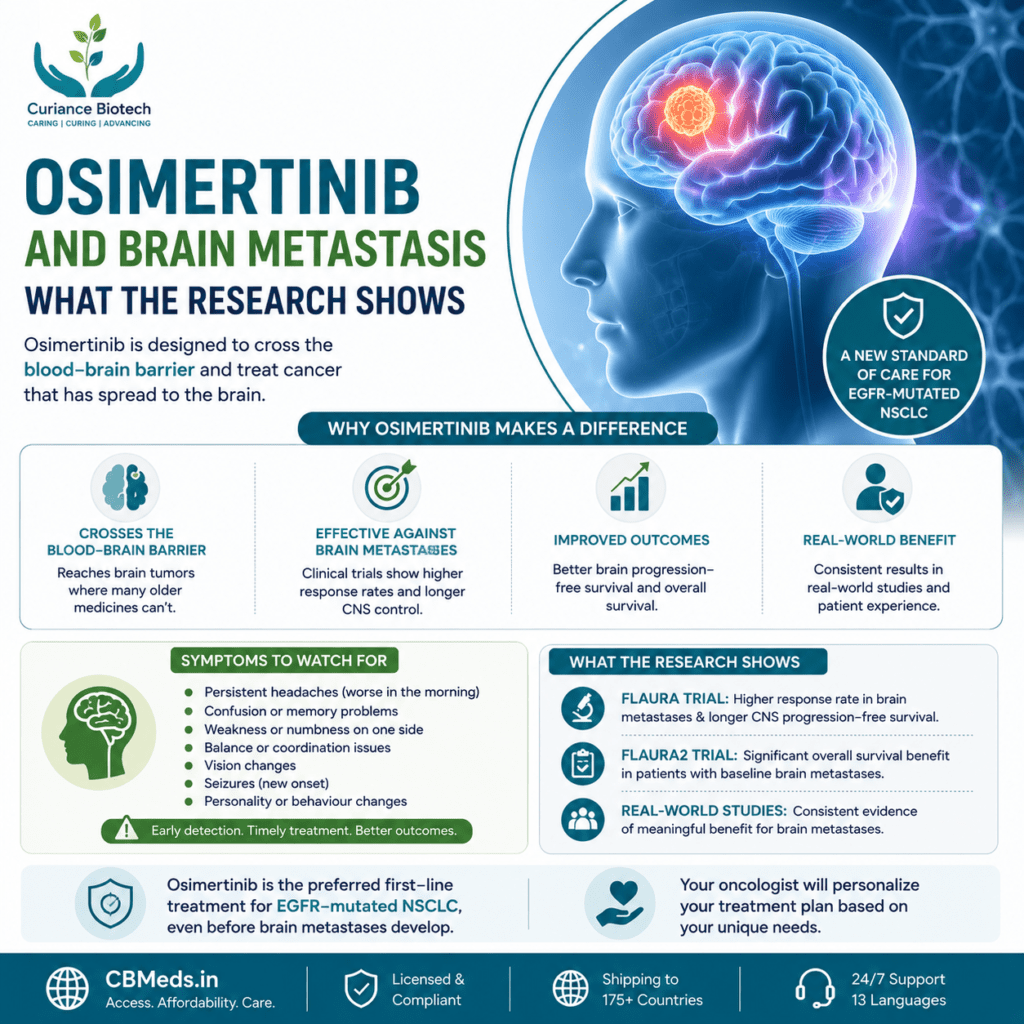
For patients with EGFR-mutated NSCLC, one of the most worrying possibilities is that the cancer could spread to the brain.
Brain metastases occur in a significant proportion of advanced lung cancer patients, and historically, treating cancer that has spread to the brain has been particularly difficult.
This is where Osimertinib has made a genuine difference. Unlike many earlier cancer therapies, Osimertinib is specifically effective against brain metastases — and this guide explains why, and what the research shows.
Why Brain Metastases Are Difficult to Treat
The brain is protected by a structure called the blood-brain barrier — a tightly regulated layer of cells that controls what substances can pass from the bloodstream into brain tissue.
This barrier exists to protect the brain from harmful substances, but it also blocks many cancer medicines from reaching tumours that have spread there.
This means that even when a cancer medicine works very well against tumours elsewhere in the body, it may not effectively treat the same cancer if it has spread to the brain because the medicine simply cannot cross the blood-brain barrier in sufficient quantities.
For lung cancer patients, brain metastases are unfortunately common.
EGFR-mutated NSCLC has a particular tendency to spread to the brain, with some studies showing that up to 25–30% of patients will develop brain metastases at some point during their illness.
How Osimertinib Crosses the Blood-Brain Barrier
Osimertinib was specifically designed with molecular properties that allow it to cross the blood-brain barrier more effectively than earlier-generation EGFR inhibitors such as Erlotinib and Gefitinib.
This is one of the most important advantages of Osimertinib over older targeted therapies.
While first and second-generation EGFR inhibitors had limited ability to reach brain tissue, Osimertinib achieves significantly higher concentrations in the brain and cerebrospinal fluid — meaning it can directly treat tumours that have spread there, not just tumours in the lung.
What the Clinical Evidence Shows
FLAURA Trial — CNS Response Data
The original FLAURA trial, which established Osimertinib as the standard first-line treatment for EGFR-mutated NSCLC, included a specific analysis of patients with central nervous system (CNS) metastases at the start of treatment.
The results showed that Osimertinib achieved a significantly higher response rate in brain metastases compared to older EGFR inhibitors, along with longer central nervous system progression-free survival.
FLAURA2 — Combination Therapy and Brain Metastases
The more recent FLAURA2 trial, which combined Osimertinib with platinum-based chemotherapy, specifically examined outcomes in patients with brain metastases at baseline — a group considered higher risk.
The 2026 overall survival update showed particular benefit in this higher-risk subgroup, which is part of why oncologists now consider the combination regimen specifically for patients with brain involvement.
Real-World Evidence
Beyond clinical trials, real-world studies published in oncology journals have consistently supported these findings — showing that patients with EGFR-mutated NSCLC and brain metastases who receive Osimertinib have meaningfully better brain-specific outcomes compared to those treated with older-generation EGFR inhibitors or chemotherapy alone.
What This Means in Practice
If you or your loved one has EGFR-mutated lung cancer with brain metastases, this evidence means:
Osimertinib May Be Effective Against Brain Tumours Directly
Osimertinib may be effective against brain tumours directly — not just the lung tumour — without necessarily requiring additional brain-specific treatment in every case.
Additional Brain Treatment May Still Be Needed
Depending on the size, number, and location of brain metastases, and whether you have symptoms, your oncologist may recommend:
- Stereotactic radiosurgery (SRS)
- Whole-brain radiotherapy (WBRT)
alongside Osimertinib treatment.
Regular Brain Imaging Remains Important
Your oncology team will likely schedule periodic MRI scans of the brain to monitor how well treatment is controlling metastases, even if you have no symptoms.
Symptoms of Brain Metastases to Be Aware Of
It is helpful to know the warning signs of brain metastases, particularly if you have EGFR-mutated lung cancer.
Seek medical advice if you experience:
- Persistent headaches, particularly worse in the morning
- New or worsening confusion
- Memory difficulties
- Weakness or numbness on one side of the body
- Difficulty with balance or coordination
- Vision changes
- New-onset seizures
- Personality or behavioural changes
These symptoms do not necessarily mean cancer has spread to the brain, but they should always be evaluated.
Osimertinib and Leptomeningeal Disease
A more advanced and serious form of central nervous system spread is called leptomeningeal disease.
This occurs when cancer cells spread into the fluid and membranes surrounding the brain and spinal cord.
Historically, this has been one of the most difficult complications of lung cancer to treat.
Research has shown that Osimertinib — including at a higher dose in selected protocols — can have meaningful activity against leptomeningeal disease in EGFR-mutated patients.
This represents a significant advance for what was previously a very difficult-to-treat complication.
Why This Matters for Treatment Decisions
The brain-penetrating ability of Osimertinib is one of the key reasons it has become the preferred first-line treatment for EGFR-mutated NSCLC over older-generation EGFR inhibitors.
Even in patients who do not yet have known brain metastases, this benefit remains important.
Because EGFR-mutated lung cancer carries a meaningful risk of brain involvement over time, using a treatment capable of addressing brain disease is an important part of modern treatment planning.
Frequently Asked Questions
Does Everyone with EGFR-Mutated Lung Cancer Get Brain Metastases?
No.
While EGFR-mutated NSCLC has a higher tendency to spread to the brain compared to some other lung cancer subtypes, not all patients develop brain metastases.
Regular monitoring helps detect them early if they occur.
If I Already Have Brain Metastases, Is It Too Late for Osimertinib to Help?
No.
Clinical evidence shows Osimertinib is effective against existing brain metastases, not just for prevention.
Many patients diagnosed with brain metastases have responded well to treatment.
Will I Need Radiation Therapy in Addition to Osimertinib?
This depends on:
- Number of lesions
- Size of lesions
- Location of lesions
- Symptoms
Your oncologist and radiation oncologist will determine the most appropriate treatment plan.
How Often Will I Need Brain MRI Scans?
Brain MRI monitoring every 2–3 months is common during active treatment, particularly if there is a history of brain involvement.
Your oncology team will determine the appropriate schedule.
Can Osimertinib Prevent Brain Metastases?
While no treatment can completely guarantee prevention, Osimertinib’s ability to cross the blood-brain barrier means it provides ongoing protection against the development of new brain metastases while the cancer remains responsive to therapy.
Summary
Osimertinib’s ability to cross the blood-brain barrier is one of its most clinically important features.
Clinical trial evidence from the FLAURA trial, the FLAURA2 trial, and real-world studies consistently show meaningful benefit for patients with EGFR-mutated NSCLC and brain metastases.
Osimertinib can help:
- Treat existing brain metastases
- Delay progression in the central nervous system
- Reduce the risk of new brain lesions developing
If you have EGFR-mutated lung cancer with brain metastases, discuss with your oncologist how Osimertinib fits into your treatment strategy and whether additional therapies may be appropriate.
Accessing Osimertinib Through CBMeds
If you or your patient has been prescribed Osimertinib for EGFR-mutated lung cancer with brain involvement, CBMeds can help you access it — wherever you are in the world.
We supply Osimertinib to patients in 175 countries with a valid oncologist prescription, handling all documentation and delivering in 15–20 days.
📧 info@cbmeds.in
🕐 Available 24/7
🌍 Shipping to 175 Countries
🗣 Support in 13 Languages


