
Introduction
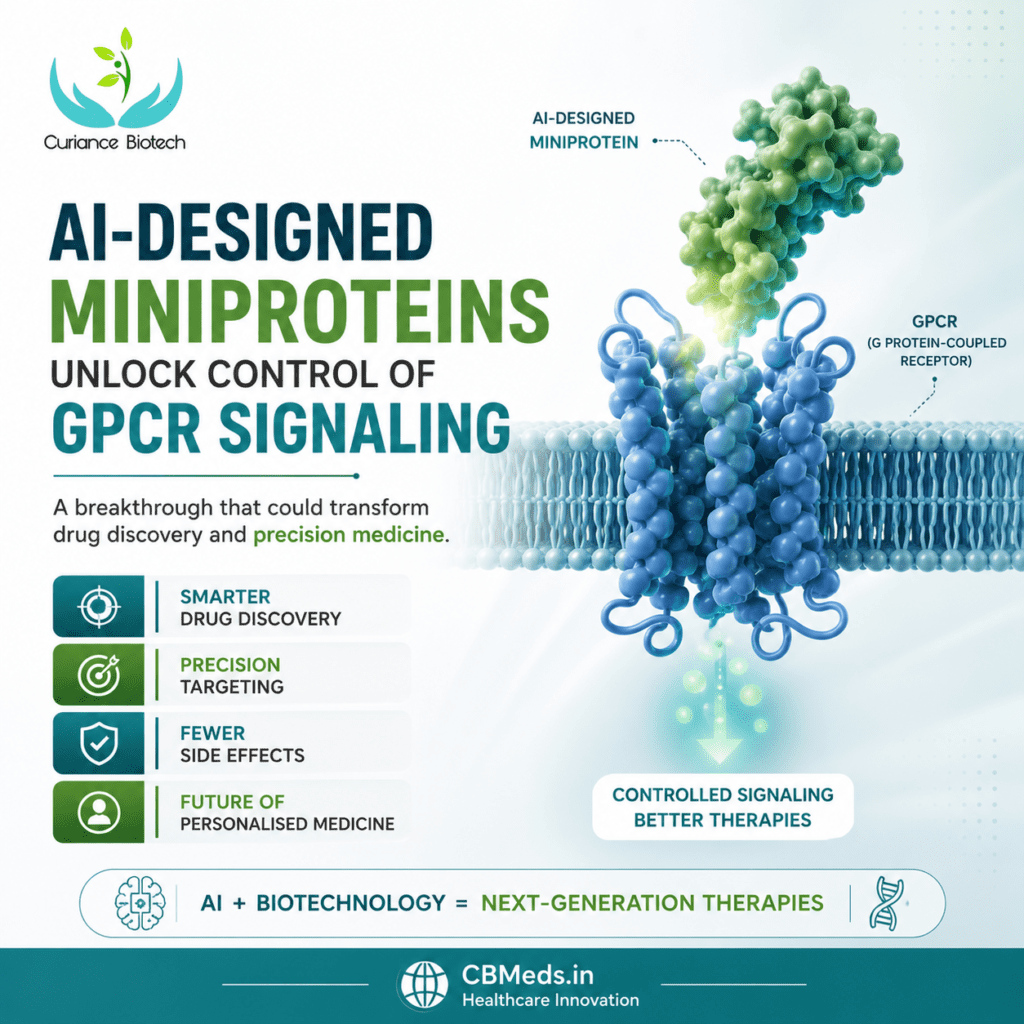
Artificial intelligence is rapidly transforming healthcare and biomedical research. From analysing medical images to accelerating drug discovery, AI is helping scientists solve problems that once required years of laboratory work. One of the latest breakthroughs involves AI-designed miniproteins capable of controlling G protein-coupled receptor (GPCR) signaling, a development that could revolutionise modern medicine.
GPCRs are among the most important proteins in the human body. They regulate how cells respond to hormones, neurotransmitters, and external stimuli. Because of their critical role in human health, GPCRs are the target of approximately one-third of all approved medications.
Now, researchers are using advanced AI systems to design tiny proteins known as miniproteins that can precisely control GPCR signaling pathways. This innovation could pave the way for more effective treatments with fewer side effects and usher in a new era of precision medicine.
Understanding GPCRs: The Body’s Communication Network
To appreciate the significance of this breakthrough, it is important to understand what GPCRs are and why they matter.
G protein-coupled receptors are specialised proteins located on the surface of cells. They act as communication gateways, allowing cells to receive and respond to signals from their environment.
These signals can include:
- Hormones
- Neurotransmitters
- Growth factors
- Odor molecules
- Light signals
When a signaling molecule binds to a GPCR, it triggers a chain of events inside the cell. This process helps regulate countless biological functions.
GPCRs influence:
- Heart rate
- Blood pressure
- Mood
- Vision
- Immune responses
- Metabolism
- Pain perception
- Brain function
Because GPCRs are involved in so many physiological processes, they represent one of the most important targets in pharmaceutical research.
Why GPCRs Are Important in Medicine
Many widely used medications work by targeting GPCRs.
Examples include drugs used to treat:
- Hypertension
- Asthma
- Depression
- Allergies
- Parkinson’s disease
- Heart disease
- Migraines
Despite their importance, controlling GPCR activity with high precision has remained a major challenge.
Traditional drugs often activate or block GPCRs broadly, which can lead to unwanted side effects. Scientists have long searched for methods that provide more selective control over these receptors.
This is where AI-designed miniproteins enter the picture.
What Are Miniproteins?
Miniproteins are small engineered proteins designed to perform highly specific biological functions.
Unlike larger proteins, miniproteins are:
- Compact
- Stable
- Easier to engineer
- Highly targeted
Because of their small size, they can interact with cellular structures in unique ways.
Researchers can design miniproteins to:
- Bind specific receptors
- Activate signaling pathways
- Block unwanted signals
- Deliver therapeutic molecules
Historically, designing functional proteins from scratch was extremely difficult and time-consuming.
Artificial intelligence is changing that reality.
The Role of AI in Protein Design
Traditional protein engineering often involves years of trial and error.
Scientists must:
- Create protein variations.
- Test them experimentally.
- Analyse results.
- Repeat the process countless times.
AI dramatically accelerates this workflow.
Advanced machine-learning models can predict:
- Protein structures
- Folding patterns
- Binding interactions
- Functional behaviour
Using enormous biological datasets, AI systems can generate entirely new protein designs that do not exist in nature.
Researchers can then identify candidates with the highest probability of success before laboratory testing even begins.
This approach saves time, reduces costs, and expands the possibilities for biomedical innovation.
How AI-Designed Miniproteins Control GPCR Signaling
The latest breakthrough involves designing miniproteins that interact directly with GPCRs and their signaling partners.
These engineered proteins can influence how receptors communicate within cells.
Researchers have demonstrated that AI-designed miniproteins can:
- Activate specific signaling pathways
- Block unwanted receptor activity
- Enhance therapeutic responses
- Reduce off-target effects
Instead of broadly affecting an entire receptor system, these miniproteins can provide highly selective control.
This level of precision has long been a major goal in drug development.
Potential Benefits for Patients
The ability to precisely control GPCR signaling could have significant implications for patient care.
More Targeted Treatments
Current medications often affect multiple biological pathways simultaneously.
AI-designed miniproteins could allow doctors to target only the pathways involved in a particular disease.
This may improve treatment effectiveness while minimising unwanted effects.
Reduced Side Effects
Many drug side effects occur because medications interact with healthy tissues.
Highly selective miniproteins could reduce these unintended interactions.
As a result, patients may experience:
- Improved tolerability
- Better adherence to treatment
- Enhanced quality of life
Personalised Medicine
Every patient responds differently to treatment.
AI-designed proteins may eventually enable therapies tailored to an individual’s genetic and molecular profile.
This represents a major step toward personalised medicine.
Applications in Cancer Treatment
Cancer remains one of the most promising areas for this technology.
Many cancers involve abnormal signaling pathways, including GPCR-related mechanisms.
AI-designed miniproteins could potentially:
- Interrupt cancer-promoting signals
- Enhance immune responses
- Improve targeted therapies
- Increase treatment precision
Researchers believe these proteins may complement existing cancer treatments such as:
- Chemotherapy
- Immunotherapy
- Targeted therapies
Implications for Neurological Disorders
The brain relies heavily on GPCR signaling.
Many neurological and psychiatric conditions involve disruptions in these pathways.
Potential future applications include:
Parkinson’s Disease
Targeted GPCR modulation could improve motor control while reducing treatment complications.
Depression and Anxiety
More precise regulation of neurotransmitter systems may improve mental health therapies.
Alzheimer’s Disease
Researchers are investigating whether selective signaling control can protect neurons and slow disease progression.
Cardiovascular Disease Applications
Heart health depends on tightly regulated cellular communication.
GPCRs influence:
- Blood pressure
- Heart rhythm
- Vascular function
AI-designed miniproteins may eventually help treat:
- Hypertension
- Heart failure
- Arrhythmias
- Vascular disorders
By targeting specific signaling pathways, treatments could become safer and more effective.
Accelerating Drug Discovery
One of the most exciting aspects of AI-driven protein design is its impact on pharmaceutical research.
Drug development traditionally requires:
- 10 to 15 years
- Billions of dollars
- Extensive testing
AI can shorten early-stage discovery significantly.
Benefits include:
Faster Candidate Identification
Researchers can evaluate thousands of protein designs in a fraction of the time.
Reduced Research Costs
Computational design lowers the need for extensive laboratory screening.
Improved Success Rates
AI helps identify candidates with greater likelihood of clinical success.
Collectively, these improvements may speed the delivery of new therapies to patients.
Challenges and Limitations
Although promising, AI-designed miniproteins remain an emerging technology.
Several challenges must still be addressed.
Safety Testing
All new therapeutic proteins require extensive safety evaluation before human use.
Manufacturing Complexity
Producing protein-based therapies at large scale can be technically demanding.
Regulatory Approval
Regulatory agencies must evaluate safety, effectiveness, and manufacturing quality.
Long-Term Effects
Researchers need more data regarding long-term outcomes and potential risks.
Despite these challenges, progress continues at a remarkable pace.
The Future of AI-Powered Biotechnology
The success of AI-designed miniproteins represents a broader transformation occurring throughout biotechnology.
Scientists are increasingly combining:
- Artificial intelligence
- Structural biology
- Genomics
- Protein engineering
- Precision medicine
Together, these fields are reshaping how therapies are discovered and developed.
Future innovations may include:
- AI-designed vaccines
- Smart therapeutic proteins
- Personalised biologics
- Next-generation cancer treatments
- Advanced regenerative medicine
As computational capabilities continue to improve, entirely new categories of medicines may emerge.
Why This Breakthrough Matters
The ability to control GPCR signaling with AI-designed miniproteins demonstrates the extraordinary potential of combining biology and artificial intelligence.
Rather than relying solely on traditional drug discovery methods, researchers can now design biological tools with unprecedented precision.
This advancement offers hope for:
- More effective treatments
- Reduced side effects
- Faster drug development
- Personalised healthcare solutions
Most importantly, it highlights a future where diseases may be treated more accurately than ever before.
Conclusion
The development of AI-designed miniproteins capable of controlling GPCR signaling marks a major milestone in biomedical science. By combining artificial intelligence with advanced protein engineering, researchers have created powerful tools that could transform how diseases are treated.
Because GPCRs play a central role in countless biological processes, the ability to regulate their activity with precision has enormous therapeutic potential. From cancer and cardiovascular disease to neurological disorders and personalised medicine, the possibilities are vast.
While further research and clinical testing remain necessary, this breakthrough represents a glimpse into the future of medicine—one where AI not only assists scientists but actively helps design the next generation of life-saving therapies.


