
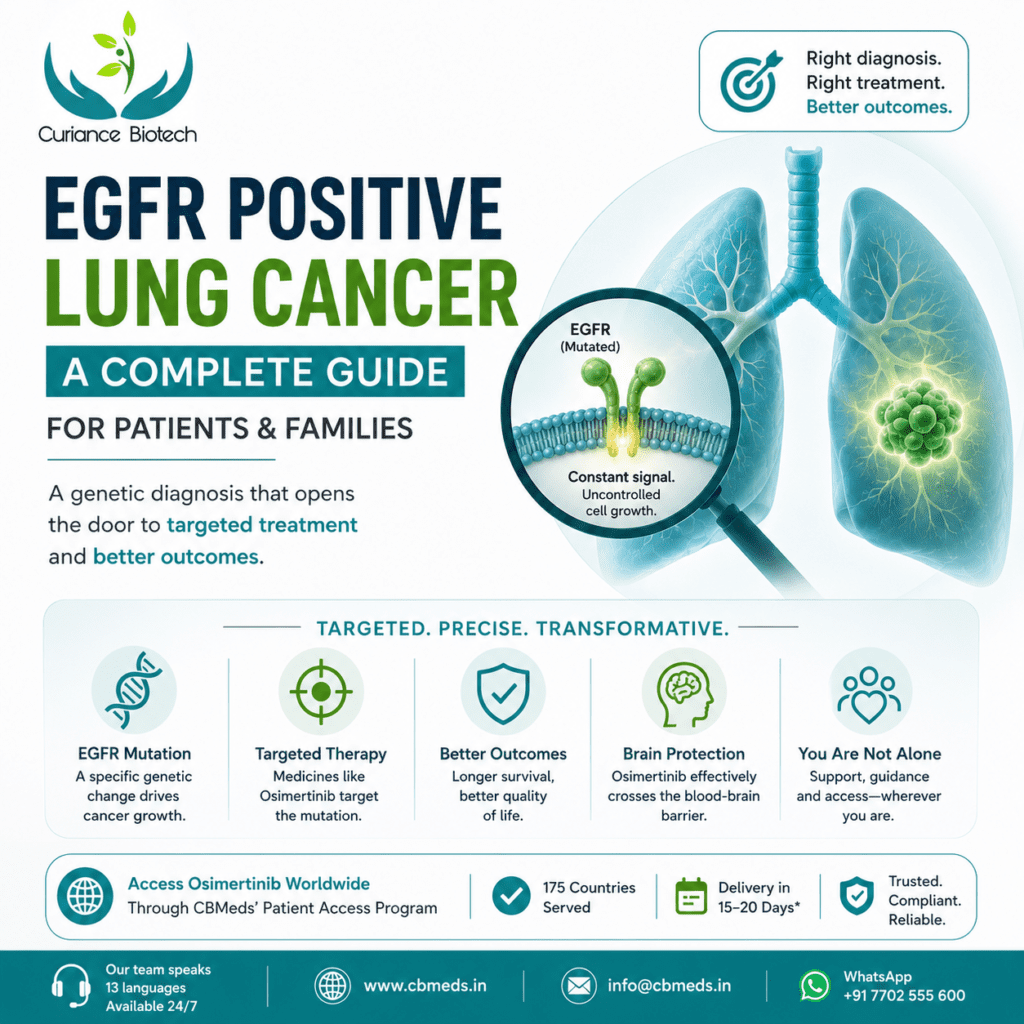
Being told you have EGFR positive lung cancer can feel overwhelming. But here is something important to know from the start: an EGFR mutation in lung cancer is not just a diagnosis — it is a specific piece of information that opens the door to some of the most effective targeted treatments available in oncology today.
This guide explains what EGFR positive lung cancer means, how it is diagnosed, what treatment options exist, and how patients around the world are accessing those treatments through CBMeds.
What Does EGFR Positive Mean in Lung Cancer?
EGFR stands for Epidermal Growth Factor Receptor — a protein found on the surface of cells that helps control how cells grow and divide. In a healthy body, EGFR acts like a switch: it turns on when cells need to grow and turns off when they do not.
In some lung cancer patients, the EGFR gene is mutated. This mutation causes the EGFR protein to become permanently switched on — like a stuck accelerator — continuously signalling cancer cells to grow and divide without stopping.
When a lung cancer tumour carries this type of mutation, it is called EGFR positive or EGFR-mutated lung cancer. This is not a different type of cancer — it is non-small cell lung cancer (NSCLC) with a specific genetic characteristic that changes how it should be treated.
The important thing to understand is this: EGFR positive lung cancer responds very well to a specific class of medicines called EGFR tyrosine kinase inhibitors (TKIs) — including Osimertinib (Tagrisso), which has transformed outcomes for eligible patients over the past decade.
How Common is EGFR Positive Lung Cancer?
EGFR mutations are one of the most common genetic drivers of lung cancer, particularly in:
- Asian patients — EGFR mutations occur in approximately 30–50% of Asian NSCLC patients
- Non-smokers and light smokers — EGFR mutations are more frequent in patients who have never smoked or smoked lightly
- Women — EGFR mutations occur slightly more commonly in women than men
- Adenocarcinoma subtype — EGFR mutations are most common in adenocarcinoma, the most frequent type of NSCLC
In Western populations, EGFR mutations occur in approximately 10–15% of NSCLC patients. Globally, this means hundreds of thousands of new EGFR-mutated lung cancer diagnoses every year.
Which EGFR Mutations Are There?
Not all EGFR mutations are the same. There are several types, and the specific mutation your tumour carries determines which treatment is most appropriate.
Exon 19 deletion
The most common EGFR mutation, accounting for approximately 45% of all EGFR-positive cases. Tumours with exon 19 deletions respond very well to Osimertinib as a first-line treatment. The FLAURA trial showed that Osimertinib more than doubled progression-free survival compared to older EGFR inhibitors in patients with this mutation.
Exon 21 L858R point mutation
The second most common EGFR mutation, accounting for approximately 40% of EGFR-positive cases. Like exon 19 deletions, L858R mutations respond well to Osimertinib as first-line treatment.
T790M resistance mutation
This mutation does not usually occur at diagnosis. It develops in approximately 50% of patients who have been on older first or second-generation EGFR inhibitors (such as Erlotinib, Gefitinib, or Afatinib) and whose cancer has started to progress. Osimertinib was specifically designed to overcome T790M resistance and is the standard treatment when this mutation is detected.
Exon 20 insertion
A less common EGFR mutation (approximately 5–10% of EGFR-positive cases) that generally does not respond to standard EGFR inhibitors including Osimertinib. Different targeted treatments are being developed for this subtype.
Other uncommon mutations
A small number of patients have other, rarer EGFR mutations. Your oncologist will interpret your mutation test results and advise on the most appropriate treatment.
How is EGFR Mutation Tested?
Before starting any targeted therapy, your oncologist needs to confirm which EGFR mutation — if any — is present in your tumour. This is done through molecular testing, which can be performed in two ways:
Tissue biopsy
A sample of tumour tissue is taken — either through bronchoscopy, CT-guided biopsy, or from a surgical specimen — and sent to a molecular pathology laboratory for EGFR mutation analysis. This is the most common method and provides the most detailed genetic information.
Liquid biopsy (blood test)
A blood sample is taken and analysed for circulating tumour DNA (ctDNA) — fragments of DNA released by cancer cells into the bloodstream. Liquid biopsy is less invasive and can be done quickly, though it is slightly less sensitive than tissue biopsy. It is increasingly used for monitoring treatment response and detecting resistance mutations like T790M.
If you have been diagnosed with NSCLC and have not yet had EGFR testing, speak to your oncologist about requesting it. EGFR testing is now recommended for all patients with non-squamous NSCLC by major international oncology guidelines including ESMO and ASCO.
Treatment Options for EGFR Positive Lung Cancer
The development of EGFR-targeted therapies has dramatically changed outcomes for EGFR-positive lung cancer patients. The treatment landscape as of 2026 is as follows:
First-line treatment — Osimertinib (Tagrisso / generic)
Osimertinib is now the standard first-line treatment for patients with exon 19 deletion or exon 21 L858R EGFR-mutated advanced or metastatic NSCLC. The FLAURA trial showed a median progression-free survival of 18.9 months with Osimertinib versus 10.2 months with older EGFR inhibitors. The updated FLAURA2 data published in 2026 showed that combining Osimertinib with chemotherapy extended median overall survival to 47.5 months.
First-line treatment — Osimertinib plus chemotherapy (FLAURA2 regimen)
Based on the FLAURA2 trial, some oncologists are now offering a combination of Osimertinib plus platinum-based chemotherapy as a first-line option for patients with high-risk features such as brain metastases or high disease burden. Discuss with your oncologist whether this applies to your situation.
Second-line treatment after resistance — Osimertinib for T790M
For patients who progressed on first or second-generation EGFR inhibitors and have developed the T790M mutation, Osimertinib is the approved second-line treatment.
Adjuvant therapy after surgery — Osimertinib (ADAURA trial)
For patients with early-stage EGFR-mutated NSCLC who have undergone complete surgical tumour removal, Osimertinib is now recommended as adjuvant therapy for 3 years to significantly reduce the risk of recurrence.
Locally advanced unresectable disease — Osimertinib after chemoradiotherapy (LAURA trial)
The LAURA trial, with results presented in 2025, showed that Osimertinib significantly improved outcomes for patients with unresectable stage III EGFR-mutated NSCLC after concurrent chemoradiotherapy — a newly approved indication.
Older EGFR inhibitors (first and second generation)
Erlotinib (Tarceva), Gefitinib (Iressa), and Afatinib (Giotrif) were the predecessors to Osimertinib. They are less commonly recommended as first-line treatment now because Osimertinib has shown superior outcomes across multiple clinical trials. However, they may be used in specific situations or where Osimertinib is not available.
Why EGFR Positive Lung Cancer Has a Better Prognosis
One of the most important things for newly diagnosed EGFR-positive patients to understand is that this mutation, while still a serious diagnosis, is associated with better treatment outcomes than EGFR-negative NSCLC.
This is because EGFR-positive tumours have a clear, targetable driver mutation. Osimertinib specifically targets that driver. The result is that EGFR-positive patients on Osimertinib typically experience longer progression-free survival, a higher response rate (around 80% of patients see tumour shrinkage), better quality of life compared to chemotherapy, and effective brain metastasis control due to Osimertinib’s ability to cross the blood-brain barrier.
This does not mean EGFR-positive lung cancer is easy to treat — it is still a serious illness that requires ongoing monitoring and management. But the availability of targeted therapy like Osimertinib has genuinely transformed what is possible for these patients.
The Challenge of Access
Despite the effectiveness of m, access remains a significant challenge for many patients worldwide.
Brand Tagrisso costs USD 7,000–15,000 per month in Western markets. In many countries across Africa, Asia, the Middle East, and Latin America, Tagrisso is either not commercially available or completely unaffordable for most patients.
This is the gap that CBMeds was built to fill. We supply generic Osimertinib — which contains the identical active ingredient — to patients in 175 countries under the Named Patient Medicine framework. With a valid prescription from your oncologist, we can get Osimertinib to you wherever you are in the world, in 15–20 days.
How CBMeds Helps EGFR Positive Lung Cancer Patients
CBMeds (Curiance Biotech) is an ISO-certified, licensed pharmaceutical distributor based in India with over 7 years of experience in international oncology medicine access. We are registered with the Dutch Ministry of Health and have served patients in 175 countries.
If you or your patient has been diagnosed with EGFR-positive lung cancer and prescribed Osimertinib, here is how we help:
- Contact us via WhatsApp, email, or our web form — we respond within 2 hours
- Share your oncologist’s prescription (a digital copy is fine)
- We confirm availability and provide a transparent quote including shipping
- We handle all export and regulatory documentation for your country
- Your medicine is delivered to your door in 15–20 days
Our team speaks 13 languages and is available 24/7.
Frequently Asked Questions
If I have EGFR positive lung cancer, will Osimertinib definitely work for me?
Osimertinib works for patients with specific EGFR mutations — primarily exon 19 deletions, exon 21 L858R mutations, and T790M resistance mutations. Approximately 80% of eligible patients see significant tumour response. Your oncologist will determine whether Osimertinib is the right treatment for your specific mutation profile and overall health.
Can EGFR positive lung cancer spread to the brain?
Yes. Lung cancer can spread to the brain in any patient, including those with EGFR mutations. However, Osimertinib has a particularly important advantage here — it crosses the blood-brain barrier effectively, meaning it can treat both the primary lung tumour and brain metastases. This is one reason it is preferred over older EGFR inhibitors.
How long does Osimertinib work before resistance develops?
Most patients on first-line Osimertinib remain on treatment for approximately 18–24 months before resistance develops, though many patients remain on treatment for considerably longer. The FLAURA2 combination regimen has shown even longer duration of response in some patients.
Is EGFR positive lung cancer hereditary?
EGFR mutations found in lung cancer are almost always somatic mutations — meaning they occur in the tumour cells during a person’s lifetime and are not inherited from parents or passed to children. They are not the same as germline EGFR mutations, which are extremely rare.
What happens after Osimertinib stops working?
When Osimertinib stops working, your oncologist will typically recommend a repeat biopsy to identify the new resistance mechanism. Treatment options may include chemotherapy combinations, other targeted agents depending on the resistance mechanism, or clinical trials. CBMeds can also help access other oncology medicines used in later lines of treatment.
Summary — Key Points About EGFR Positive Lung Cancer
- EGFR positive lung cancer means your tumour carries a mutation in the EGFR gene that drives cancer cell growth
- It is most common in Asian patients, non-smokers, women, and adenocarcinoma subtype
- The most common mutations are exon 19 deletion and exon 21 L858R — both highly responsive to Osimertinib
- Osimertinib (Tagrisso / generic) is the standard first-line treatment and has transformed outcomes
- 2026 FLAURA2 data shows combination with chemotherapy extends overall survival to 47.5 months
- Access to Osimertinib remains a challenge — CBMeds supplies it to 175 countries with a valid prescription
- Always work with your oncologist to confirm your specific mutation and the most appropriate treatment plan
Need Help Accessing Osimertinib for EGFR Positive Lung Cancer?
CBMeds has helped thousands of EGFR-positive lung cancer patients across 175 countries access Osimertinib legally and affordably. We respond within 2 hours and handle all documentation.
📧 info@cbmeds.in | Available 24/7 | 13 languages supported | +919893126754


