
One of the most common questions patients and caregivers ask after a new prescription is simple: why this dose, and not the other one?
Osimertinib is available in two strengths — 40 mg and 80 mg — and the choice between them depends on several factors specific to each patient.
This guide explains how Osimertinib dosing works, why your oncologist chose your specific dose, what to do if you miss a dose, and when a dose adjustment might be needed.
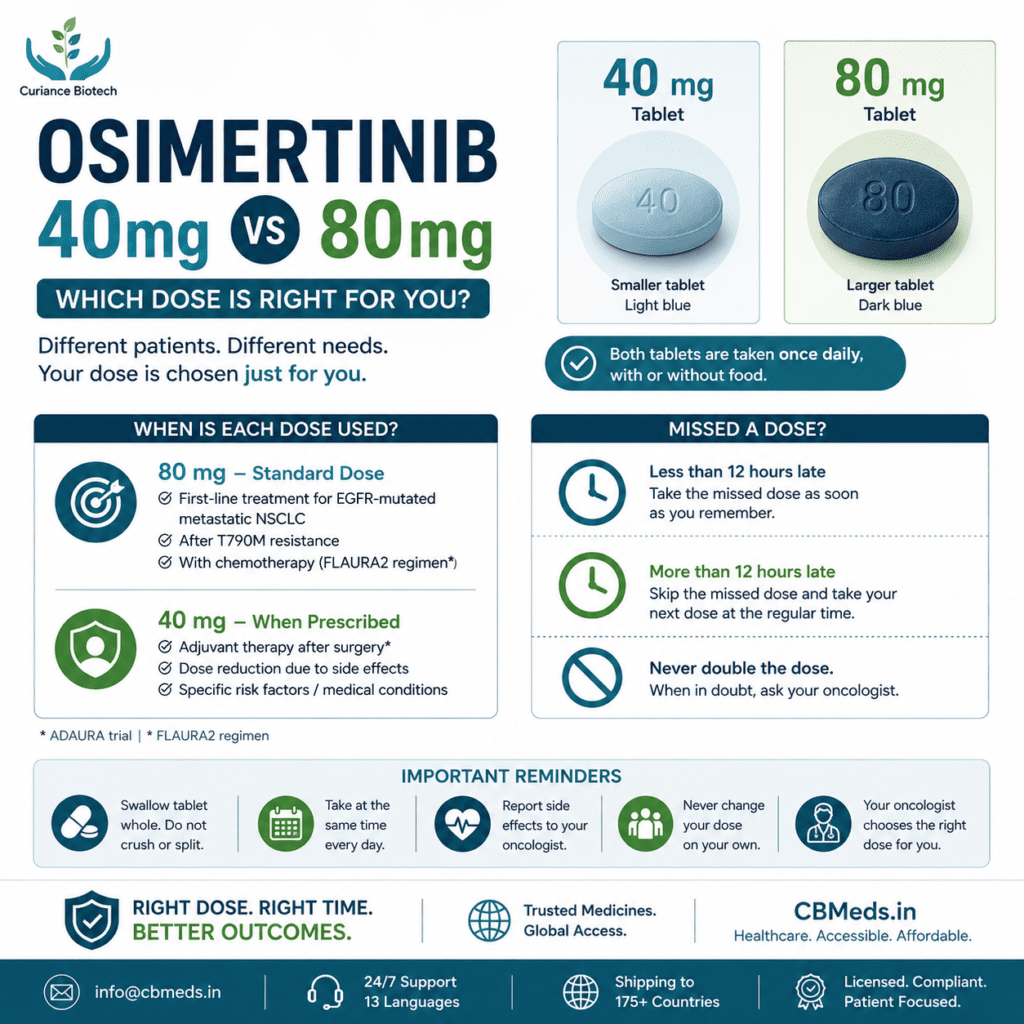
The Two Available Doses
Osimertinib comes as a film-coated tablet in two strengths:
40 mg Tablet
A smaller, light blue tablet.
80 mg Tablet
A larger, dark blue tablet.
Both are taken orally, once daily, with or without food, at approximately the same time each day.
Standard Dosing — 80mg Once Daily
For most adult patients, the standard recommended dose of Osimertinib is 80 mg once daily.
This is the dose used in the majority of clinical trials and is the standard starting dose for:
First-Line Treatment of Metastatic EGFR-Mutated NSCLC
For patients newly diagnosed with exon 19 deletion or exon 21 L858R mutations, 80 mg once daily is the standard first-line dose, as established in the FLAURA trial.
Treatment After T790M Resistance
For patients who progressed on earlier EGFR inhibitors and developed the T790M resistance mutation, 80 mg once daily is also the standard dose.
First-Line Treatment Combined with Chemotherapy (FLAURA2 Regimen)
Patients receiving the newer combination regimen of Osimertinib plus platinum-based chemotherapy also typically receive the standard 80 mg dose of Osimertinib alongside their chemotherapy cycles.
When Is 40mg Prescribed?
The 40 mg dose is used in specific situations.
Adjuvant Therapy After Surgery
Following the ADAURA trial, patients who have undergone surgical removal of an early-stage EGFR-mutated tumour may be prescribed Osimertinib as adjuvant therapy to reduce the risk of recurrence.
Note: Some adjuvant protocols use 80 mg. Your oncologist will determine the appropriate regimen.
Dose Reduction Due to Side Effects
If a patient experiences significant side effects on the 80 mg dose, such as:
- Severe diarrhoea
- Significant skin reactions
- QT prolongation
- Other clinically important adverse effects
the oncologist may reduce the dose to 40 mg once daily while maintaining treatment effectiveness.
Patients with Specific Risk Factors
In selected cases, oncologists may start treatment at a lower dose based on:
- Liver impairment
- Co-existing medical conditions
- Individual risk factors
The decision is always made on a case-by-case basis.
Important
Never change your dose without consulting your oncologist.
How to Take Osimertinib
Take It at the Same Time Every Day
Taking Osimertinib consistently helps maintain stable medicine levels in your body.
Can Be Taken With or Without Food
Food does not significantly affect absorption.
Some patients find taking it with a light meal helps reduce nausea.
Swallow the Tablet Whole
Do not:
- Crush
- Split
- Chew
If swallowing tablets is difficult, the tablet can be dispersed in non-carbonated water according to your oncologist’s instructions.
Build a Routine
Taking Osimertinib at the same time every day reduces the likelihood of missed doses.
What to Do If You Miss a Dose
Less Than 12 Hours Late
Take the missed dose as soon as you remember.
Then continue your normal schedule.
More Than 12 Hours Late
Skip the missed dose completely.
Take your next dose at the regular scheduled time.
Never Double Dose
Do not take two doses together to make up for a missed tablet.
What If You Vomit After Taking a Dose?
If vomiting occurs after taking Osimertinib:
- Do not take another tablet
- Wait until the next scheduled dose
If vomiting becomes frequent, contact your oncology team.
Dose Adjustments for Side Effects
If side effects become difficult to manage, your oncologist may consider:
Temporary Treatment Interruption
Treatment may be paused briefly while symptoms improve.
Dose Reduction
Reducing from 80 mg to 40 mg once daily is a common strategy for managing persistent side effects.
Treatment Discontinuation
In rare cases involving serious adverse reactions, treatment may need to be permanently stopped.
Examples include:
- Severe interstitial lung disease
- Serious cardiac complications
- Life-threatening reactions
All dose adjustments should be directed by your oncologist.
Dosing in Special Populations
Elderly Patients
No routine dose adjustment is required based solely on age.
However, closer monitoring may be appropriate.
Liver Impairment
Patients with severe liver dysfunction may require additional monitoring.
Your oncologist will review liver function tests regularly.
Kidney Impairment
Mild to moderate kidney impairment usually does not require dose modification.
Severe kidney disease requires individual assessment.
Drug Interactions
Some medicines may affect how Osimertinib works.
Examples include:
- Certain antibiotics
- Antifungal medicines
- Anti-epileptic medications
- Herbal supplements
Always tell your doctor about every medicine or supplement you take.
How Long Is Osimertinib Taken For?
Treatment duration depends on your specific situation.
Metastatic EGFR-Mutated Lung Cancer
Treatment is usually continued for as long as:
- The cancer remains controlled
- Side effects remain manageable
Many patients remain on treatment for several years.
Adjuvant Treatment After Surgery
Patients receiving adjuvant Osimertinib typically continue treatment for three years according to current protocols.
Frequently Asked Questions
Can I Take Osimertinib at Different Times Each Day?
It is best to take it at approximately the same time daily.
Occasional variations of a few hours are unlikely to significantly affect treatment.
Is a Higher Dose More Effective?
No.
The 80 mg dose is the standard dose established through clinical trials.
Taking more than prescribed increases side effect risk and does not improve effectiveness.
What If I Was Prescribed 40mg But Want 80mg?
Always discuss this with your oncologist.
Dose selection is based on your individual medical situation.
Does Osimertinib Interact With Food?
Osimertinib can be taken with or without food.
Discuss grapefruit and grapefruit juice with your healthcare provider, as interactions may occur with some cancer medicines.
Can I Split an 80mg Tablet to Create a 40mg Dose?
No.
Osimertinib tablets should not be split, crushed, or chewed.
If a 40 mg dose is required, you should receive the appropriate 40 mg tablet.
Accessing the Correct Dosage Through CBMeds
CBMeds supplies both 40 mg and 80 mg Osimertinib tablets, exactly as specified by your oncologist.
We never substitute or alter the prescribed dose.
If you require Osimertinib for delivery to your country, simply provide a valid prescription and our team will:
- Confirm availability
- Provide a transparent quotation
- Handle documentation
- Arrange international delivery
Key Takeaways
- Osimertinib is available in 40 mg and 80 mg strengths.
- 80 mg once daily is the standard dose for most patients.
- 40 mg may be used for dose reductions or specific treatment situations.
- Missed doses should never be doubled.
- Dose adjustments should only be made by your oncologist.
- Treatment duration varies based on cancer stage and treatment goals.
- Both strengths are available through CBMeds with a valid prescription.
Need Help Accessing Osimertinib?
📧 Email: info@cbmeds.in
🌍 Available in 175 Countries
🕐 Support Available 24/7
💬 Multilingual Assistance in 13 Languages


