
If you have been researching how to access a medicine like Osimertinib that isn’t available or affordable in your country, you have likely come across the term “Named Patient Medicine.”
This guide explains exactly what it means, why it exists, and how it works in practice.
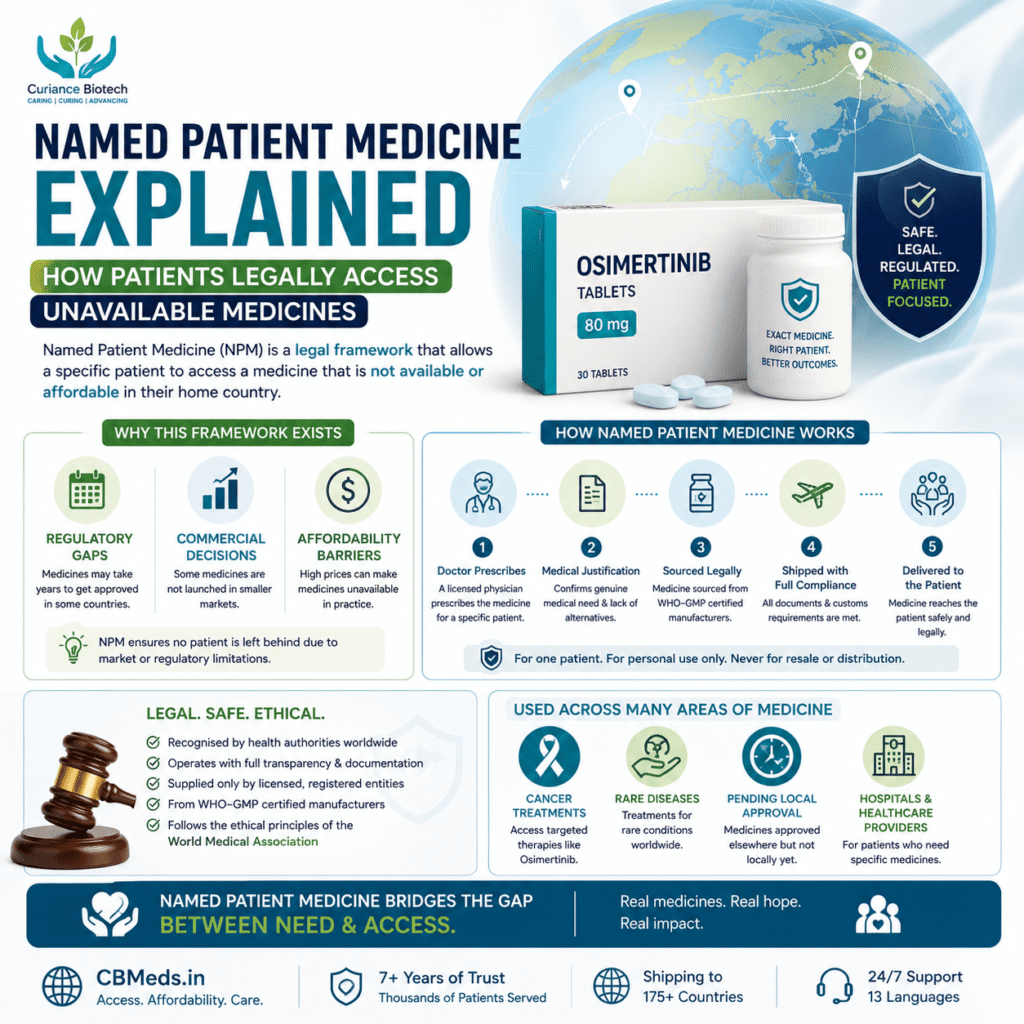
What is Named Patient Medicine?
Named Patient Medicine (NPM) — also referred to as Named Patient Supply, Named Patient Programme, or Named Patient Import depending on the country — is a legal framework that allows a specific, identified patient to receive a medicine that is not commercially licensed, registered, or readily available in their home country.
The key word is “named” — the medicine is requested and supplied for one specific, identified patient, based on a prescription from their treating physician.
It is not a general import or wholesale distribution mechanism; it exists solely to meet an individual patient’s medical need.
This framework is recognised by health authorities in the vast majority of countries worldwide, including the UK’s MHRA, Health Canada, Australia’s TGA, and equivalent bodies across Europe, Africa, the Middle East, and Asia, though the specific name and exact regulations vary by country.
Why Does This Framework Exist?
Health authorities created Named Patient Medicine pathways because they recognised a genuine and recurring problem: sometimes the medicine a patient needs is not available through normal commercial channels in their country, for reasons that have nothing to do with whether the medicine works or is safe.
Regulatory Timeline Gaps
A medicine may be approved and available in one country long before the manufacturer completes the regulatory approval process in another country.
This process can take years.
Commercial Decisions
Pharmaceutical companies sometimes choose not to launch a product in smaller markets because the expected sales volume does not justify the cost of registration and distribution.
Affordability Barriers
Even where a medicine is technically available, the price may be far beyond what most patients can afford.
Named Patient Medicine exists to ensure that individual patients are not left without access to medically necessary treatment simply because of these market and regulatory gaps.
How Does Named Patient Medicine Differ From Normal Pharmacy Supply?
Normal Pharmacy Supply
A medicine that has been through the full regulatory approval process in a country, is registered with the national health authority, and can be dispensed by any licensed pharmacy to any patient with a valid prescription.
Named Patient Medicine
A medicine that has not gone through the full registration process in a specific country, but is supplied for one named patient based on their physician’s prescription and a determination that there is a genuine medical need that cannot otherwise be met.
In both cases, a valid prescription from a licensed physician is required.
The difference lies in the regulatory status of the medicine in that specific country.
The Legal Requirements
While requirements vary by country, Named Patient Medicine supply generally requires:
1. Valid Prescription
A valid prescription from a licensed physician specifically naming:
- The patient
- The medicine required
- The treatment plan
2. Personal Therapeutic Use
The medicine must be intended solely for that patient’s personal treatment.
It cannot be resold, redistributed, or used commercially.
3. Medical Justification
In some countries, documentation may be required explaining why locally available treatment options are not suitable or accessible.
4. Import Documentation
When medicine is shipped internationally, documentation may include:
- Commercial invoice
- Certificate of origin
- Customs declaration
- Import permit (where applicable)
5. Quality-Assured Source
The medicine must come from a legitimate supplier with evidence of compliance with WHO Good Manufacturing Practice (GMP) standards or equivalent.
Who Uses Named Patient Medicine Programmes?
Named Patient Medicine pathways are used across multiple therapeutic areas.
Cancer Patients
Patients accessing targeted therapies such as Osimertinib that may not be available or affordable locally.
Rare Disease Patients
Patients with uncommon conditions where commercial supply may not exist in every country.
Patients Awaiting Local Approval
Patients seeking access to medicines already approved in major markets while local registration is still ongoing.
Hospitals and Procurement Teams
Healthcare providers sourcing medicines for specific patients when conventional supply channels cannot meet demand.
Is Named Patient Medicine the Same as Grey Market or Counterfeit Medicine?
No.
This is an important distinction.
Named Patient Medicine is an official, government-recognised legal pathway provided for in pharmaceutical legislation in many countries.
It operates with:
- Full transparency
- Medical oversight
- Regulatory documentation
- Quality-controlled supply chains
This is fundamentally different from:
Grey Market Medicines
Unauthorised imports lacking proper regulatory documentation.
Counterfeit Medicines
Fake or falsified products with no quality assurance or verified active ingredient.
Named Patient Medicine suppliers source only from verified manufacturers and provide supporting documentation for every order.
How CBMeds Operates Within This Framework
CBMeds (Curiance Biotech) has operated as a Named Patient Medicine supplier for over 7 years, helping patients in 175 countries access medicines including Osimertinib.
Our compliance framework includes:
Regulatory Registrations
- Registered with the Dutch Ministry of Health as an Independent Intermediary for Medicines (No. 6730 BEM)
- Registered as a Pharmaceutical Distributor (No. 16258 G)
Quality Standards
- ISO Certified
- Quality management systems in place
- Full documentation available for supplied medicines
WHO-GMP Certified Manufacturers
All medicines are sourced exclusively from WHO-GMP certified manufacturers.
Dedicated Regulatory Team
Our team ensures every order complies with the specific requirements of the destination country.
Ethical Commitment
CBMeds follows the principles outlined by the World Medical Association, ensuring patient welfare remains central to every decision.
What Patients and Oncologists Should Know
If your oncologist has recommended a medicine that is not available locally, Named Patient Medicine may provide a legal pathway to access it.
You Need a Valid Prescription
Every request must be supported by a valid prescription from a licensed physician.
The Process Takes Time
Typical delivery timelines are approximately 15–20 days.
Planning ahead helps prevent treatment interruptions.
Documentation Matters
Working with an experienced supplier significantly reduces customs delays and regulatory complications.
Your Oncologist Can Be Involved
Many oncologists communicate directly with suppliers and provide supporting documentation on behalf of patients.
For more information, see How to Access Osimertinib in India Legally.
Frequently Asked Questions
Is Named Patient Medicine Legal in My Country?
Named Patient frameworks exist in most countries, though requirements vary.
CBMeds confirms the applicable pathway before processing any order.
Can Any Pharmacy Supply Medicines Under Named Patient Rules?
No.
Named Patient supply often requires specific licensing and regulatory registration.
Does My Government Know About My Order?
In most countries, customs and regulatory documentation form part of the normal legal process.
This transparency is what makes the framework legitimate and compliant.
What If My Country Does Not Have a Clear Named Patient Framework?
CBMeds has experience working with patients in 175 countries and can advise on country-specific pathways and limitations.
Can I Use Named Patient Medicine for Any Medicine I Want?
No.
The framework is intended for medically necessary treatments prescribed by a licensed physician and supported by appropriate medical documentation.
Summary
Named Patient Medicine is a well-established legal pathway that allows individual patients to access medically necessary treatments that are not commercially available or affordable in their home country.
It exists because regulatory and commercial differences between countries can otherwise leave patients without access to medicines they genuinely need.
For medicines such as Osimertinib, this framework has helped thousands of patients worldwide access treatment safely, legally, and with full regulatory compliance.
Need Help Accessing a Medicine Through the Named Patient Framework?
CBMeds has 7 years of experience helping patients in 175 countries access Osimertinib and other oncology medicines through the Named Patient Medicine framework.
📧 Email: info@cbmeds.in
🌍 Shipping to 175 Countries
🕐 Available 24/7
🗣 Support in 13 Languages


