
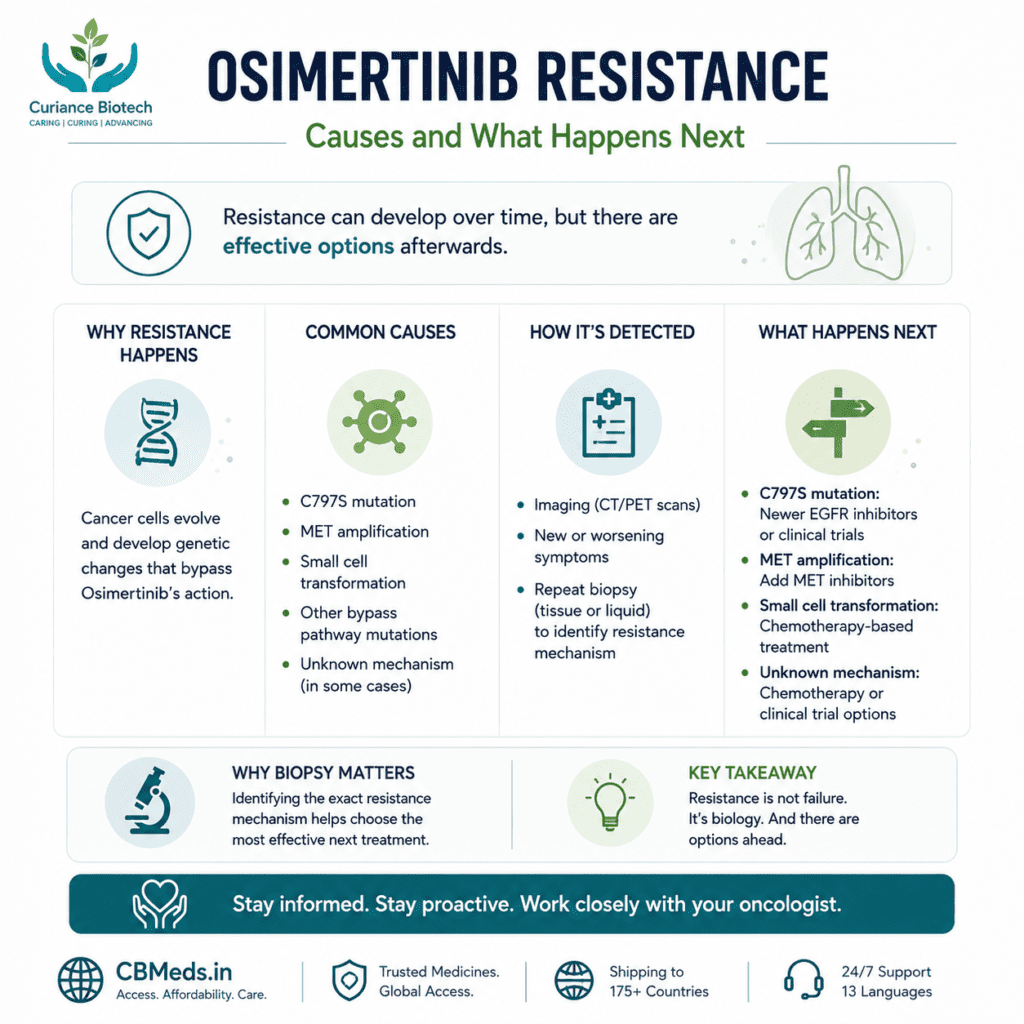
For patients doing well on Osimertinib, the possibility that it might eventually stop working can be a source of anxiety.
This is a valid concern — like most targeted cancer therapies, Osimertinib resistance can develop over time.
This guide explains why resistance happens, how it is detected, and importantly, what treatment options exist afterward.
Understanding this in advance can help you feel more prepared and know what questions to ask your oncologist if and when this situation arises.
What is Osimertinib Resistance?
Osimertinib resistance occurs when the cancer, which initially responded well to treatment, develops the ability to grow despite the medicine still being taken correctly.
This happens because cancer cells are genetically unstable and can develop new mutations or changes over time that allow them to bypass the mechanism Osimertinib uses to block them.
It is important to understand that resistance is not a failure of treatment adherence — it is a biological process that can occur even when the medicine is taken exactly as prescribed.
It reflects how cancer cells evolve under treatment pressure, not a mistake by the patient or the medical team.
How Common is Osimertinib Resistance, and When Does It Develop?
Most patients on first-line Osimertinib experience disease control for a significant period before resistance develops.
In the FLAURA trial, the median progression-free survival was 18.9 months — meaning many patients had well over a year of disease control, and a substantial proportion had considerably longer responses.
With the newer FLAURA2 combination regimen, the FLAURA2 overall survival data showed even longer outcomes, with median overall survival reaching 47.5 months in appropriately selected patients.
It is worth emphasising that these are median figures — many patients respond for considerably longer than the average, and ongoing research continues to extend these outcomes further.
What Causes Osimertinib Resistance?
Resistance to Osimertinib can develop through several different mechanisms.
Identifying which mechanism is present in your specific case is important because it directly informs what treatment comes next.
C797S Mutation
One of the most well-characterised resistance mechanisms is the C797S mutation.
This involves a new mutation in the EGFR gene itself at a specific location that prevents Osimertinib from binding effectively to the EGFR protein.
This mutation is found in a meaningful proportion of patients who develop resistance.
MET Amplification
In this mechanism, cancer cells develop extra copies of a different gene called MET.
MET provides an alternative growth signal that bypasses the EGFR pathway entirely, meaning blocking EGFR with Osimertinib is no longer sufficient to control the cancer.
Small Cell Transformation
In some cases, the cancer can transform from non-small cell lung cancer into small cell lung cancer.
This more aggressive cancer type no longer responds to EGFR-targeted therapy and usually requires a chemotherapy-based treatment approach.
Other Bypass Pathway Mutations
Additional genetic changes involving genes such as:
- HER2
- BRAF
- PIK3CA
can also allow cancer cells to bypass EGFR inhibition.
In some patients, no clear resistance mechanism is identified despite testing.
How is Resistance Detected?
Resistance is usually identified through a combination of imaging, symptoms, and molecular testing.
Imaging
Routine CT scans or PET scans may show:
- Tumour growth
- New metastatic lesions
- Disease progression
This is often the first indication that treatment effectiveness may be declining.
Symptoms
New or worsening symptoms may include:
- Persistent cough
- Breathlessness
- Pain
- Fatigue
- Weight loss
These symptoms can sometimes indicate disease progression.
Repeat Biopsy
When progression is confirmed, your oncologist will usually recommend:
- Tissue biopsy
- Liquid biopsy (blood test)
The goal is to identify the specific resistance mechanism driving progression.
This information directly influences treatment selection.
What Happens After Osimertinib Resistance Develops?
The next treatment depends heavily on which resistance mechanism is identified.
If C797S Mutation Is Found
Depending on the mutation profile, newer-generation EGFR inhibitors or combination approaches may be considered.
Clinical trials are particularly important for patients with this resistance mechanism.
If MET Amplification Is Found
Combination therapy involving:
- MET inhibitors
- Continued EGFR-targeted treatment
may be considered.
Several MET-targeted approaches are currently being studied and used in selected settings.
If Small Cell Transformation Is Found
Treatment generally shifts toward a small cell lung cancer strategy, often involving:
- Platinum-based chemotherapy
- Additional systemic therapies
EGFR-targeted therapy is usually no longer effective.
If No Clear Mechanism Is Identified
Chemotherapy remains an effective treatment option.
Many patients may also qualify for:
- Clinical trials
- Combination approaches
- Emerging targeted therapies
depending on individual circumstances.
Why the Repeat Biopsy Matters So Much
One of the most important steps after progression is identifying the resistance mechanism.
Without this information, treatment decisions become less targeted.
With a repeat biopsy, treatment can be selected based on the specific biological changes driving the cancer.
If your oncologist recommends a repeat biopsy, it is not simply an additional test — it is often the key to selecting the most effective next treatment.
Living With the Possibility of Resistance
It is natural to feel anxious about resistance, particularly if you are responding well to treatment.
A few points may help:
Focus on Your Own Results
Statistics describe populations.
Your individual outcome may be considerably different and potentially much better than average.
Stay Engaged With Monitoring
Regular scans and follow-up appointments help identify changes early when treatment options are often most effective.
Discuss Clinical Trials Early
Even if you are doing well today, understanding future options can help you feel more prepared.
The field of EGFR-mutated lung cancer treatment continues to evolve rapidly.
Frequently Asked Questions
Does Everyone on Osimertinib Eventually Develop Resistance?
Most patients with metastatic disease eventually experience some degree of progression.
However, the timing varies significantly between individuals.
Some patients maintain disease control for many years.
Can Resistance Be Prevented?
Currently, there is no established way to completely prevent resistance.
Research is focused on delaying resistance through combination approaches such as the FLAURA2 combination regimen.
If Resistance Develops, Does That Mean Treatment Has Failed?
No.
Resistance following a meaningful period of disease control does not mean treatment failed.
It reflects the natural evolution of cancer biology.
Many patients continue to benefit from subsequent therapies.
How Quickly Do I Need New Treatment?
This depends on:
- Disease progression rate
- Symptoms
- Overall health
- Biopsy findings
Your oncologist will guide the timing.
Should I Continue Taking Osimertinib While Waiting for Test Results?
This decision should always be made with your oncology team.
Never stop or change treatment without medical guidance.
Summary
Osimertinib resistance is a biological process that can develop over time in patients with metastatic EGFR-mutated lung cancer, typically after a substantial period of disease control.
Identifying the specific resistance mechanism through repeat biopsy is one of the most important steps after progression because it directly guides future treatment decisions.
Multiple treatment options exist after resistance develops, and ongoing research continues to expand the number of targeted therapies and combination approaches available.
Need Ongoing Access to Osimertinib or Related Oncology Medicines?
CBMeds supplies Osimertinib and other oncology medicines to patients in 175 countries under the Named Patient Medicine framework.
If your treatment plan changes, our team can also help you understand availability of other relevant medicines.
📧 Email: info@cbmeds.in
🌍 Shipping to 175 Countries
🕐 Available 24/7
🗣 Support in 13 Languages


