
Introduction
More than four decades after the HIV epidemic first emerged, remarkable progress has been made in prevention, diagnosis, treatment, and awareness. Millions of lives have been saved through advances in antiretroviral therapy (ART), public health campaigns, and international cooperation.
Yet despite these achievements, the fight against HIV is far from over.
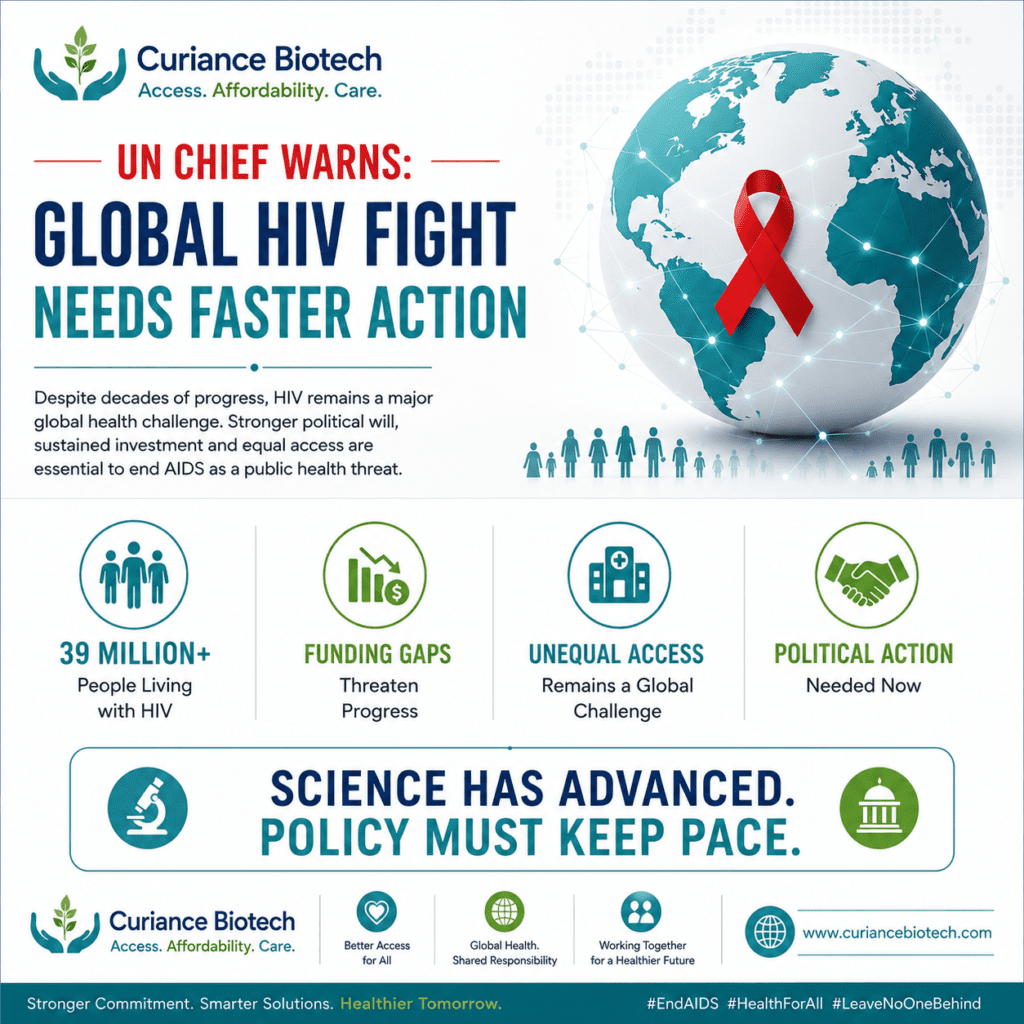
Recently, the United Nations Secretary-General issued a stark warning: the global response to HIV is at risk of losing momentum unless governments accelerate political action, strengthen healthcare systems, and ensure equitable access to prevention and treatment services.
The warning comes at a critical moment. While scientific innovation has transformed HIV from a fatal diagnosis into a manageable chronic condition for many people, persistent inequalities, funding challenges, and policy gaps continue to threaten progress.
At Curiance Biotech, we closely follow global health developments because access to life-saving medicines remains one of the defining healthcare challenges of our time. The HIV response offers important lessons about how political commitment, scientific innovation, and healthcare access must work together to improve outcomes worldwide.
The Global HIV Situation Today
HIV (Human Immunodeficiency Virus) continues to affect millions of people around the world.
According to international health organisations, approximately 39 million people are currently living with HIV globally. While significant reductions in new infections and HIV-related deaths have been achieved over the past two decades, progress has slowed in several regions.
Many countries remain off track to meet global HIV targets established by international health agencies and the United Nations.
The concern is not that effective solutions do not exist. Rather, the challenge lies in ensuring those solutions are available to everyone who needs them.
Why the UN Is Sounding the Alarm
The United Nations Secretary-General’s warning reflects growing concern that global HIV progress is becoming uneven.
Several factors are contributing to this situation:
Funding Challenges
Many HIV programmes rely on sustained international and domestic funding.
Economic pressures, competing healthcare priorities, and shifting political agendas have placed increasing strain on public health budgets.
Reduced funding can impact:
- HIV testing programmes
- Prevention campaigns
- Community outreach services
- Access to medicines
- Research initiatives
Without consistent investment, gains achieved over decades can quickly be reversed.
Persistent Health Inequalities
One of the most significant barriers to ending HIV remains unequal access to healthcare.
People living in low-resource settings often face challenges including:
- Limited access to testing
- Delayed diagnosis
- Shortages of healthcare professionals
- Restricted medicine availability
- Stigma and discrimination
These disparities can lead to worse health outcomes despite the availability of effective treatments.
Rising Vulnerability in Key Populations
Certain groups continue to experience disproportionately high HIV infection rates.
These populations may face social, economic, legal, or cultural barriers that make accessing healthcare more difficult.
The UN has emphasised the importance of ensuring that HIV prevention and treatment programmes reach vulnerable communities effectively.
Without targeted interventions, progress can remain uneven and incomplete.
How Political Leadership Influences HIV Outcomes
Political commitment has been one of the strongest drivers of HIV progress throughout the history of the epidemic.
Governments play a crucial role in:
- Funding healthcare systems
- Expanding testing programmes
- Supporting public education campaigns
- Approving treatment policies
- Reducing stigma through legislation and advocacy
Countries that have maintained strong political commitment to HIV prevention and treatment have often achieved better outcomes.
Political leadership influences not only healthcare budgets but also public attitudes toward HIV and access to care.
The Success Story of Antiretroviral Therapy
One of the greatest achievements in modern medicine has been the development of antiretroviral therapy (ART).
When HIV was first identified in the 1980s, treatment options were extremely limited.
Today, effective ART can:
- Suppress viral replication
- Protect the immune system
- Reduce HIV-related complications
- Improve quality of life
- Prevent transmission when viral suppression is maintained
For many individuals, HIV has become a manageable chronic condition rather than a life-threatening illness.
This transformation demonstrates the power of scientific research combined with healthcare access.
Prevention Remains Essential
While treatment has improved dramatically, prevention remains a cornerstone of HIV control.
Key prevention strategies include:
HIV Testing
Early diagnosis allows individuals to begin treatment sooner and reduce the risk of transmission.
Pre-Exposure Prophylaxis (PrEP)
PrEP medications have significantly reduced HIV acquisition risk among high-risk populations.
Education and Awareness
Public health campaigns continue to play an important role in promoting safer behaviours and reducing stigma.
Maternal Health Programmes
Early testing and treatment during pregnancy have dramatically reduced mother-to-child HIV transmission.
The challenge is ensuring these prevention tools reach communities consistently and equitably.
The Impact of Stigma
Despite scientific progress, stigma remains one of the biggest obstacles in the HIV response.
Fear of discrimination can discourage individuals from:
- Seeking testing
- Accessing treatment
- Disclosing their status
- Participating in prevention programmes
Reducing stigma requires:
- Public education
- Community engagement
- Supportive healthcare environments
- Inclusive policies
The UN has repeatedly highlighted stigma reduction as a critical component of achieving global HIV goals.
Why Healthcare Access Matters
The HIV response has shown that medical innovation alone is not enough.
A treatment can only improve outcomes if patients can access it.
Access challenges may include:
- Geographic barriers
- Financial constraints
- Regulatory delays
- Medicine shortages
- Healthcare infrastructure limitations
At Curiance Biotech, we believe that improving healthcare access is one of the most important priorities in global health. Whether addressing HIV, cancer, or other serious conditions, ensuring patients can obtain the treatments they need remains fundamental to improving outcomes.
The Role of International Cooperation
The fight against HIV has always been a global effort.
International organisations, governments, healthcare providers, researchers, and community groups have worked together to achieve significant progress.
Key areas of collaboration include:
- Research funding
- Medicine procurement
- Disease surveillance
- Public health campaigns
- Technical assistance
The UN Secretary-General’s recent comments underscore the need to strengthen these partnerships rather than scale them back.
Global health challenges require global solutions.
Scientific Advances Continue
Although HIV remains a major public health concern, research continues to deliver encouraging developments.
Current areas of innovation include:
Long-Acting Treatments
New formulations may reduce dosing frequency and improve adherence.
HIV Vaccines
Researchers continue working toward effective preventive vaccines.
Cure Research
Scientists are exploring strategies aimed at achieving long-term viral remission or cure.
Improved Diagnostics
Advances in testing technology are helping identify infections earlier and more accurately.
These innovations demonstrate that scientific progress remains strong.
The challenge is ensuring innovation translates into real-world impact.
Lessons for Global Health
The HIV epidemic has shaped public health in profound ways.
Key lessons include:
Early Action Matters
Delays in response can have long-term consequences.
Political Commitment Is Essential
Healthcare progress depends on sustained leadership.
Access Determines Impact
Medical breakthroughs only matter if patients can benefit from them.
Community Engagement Works
Local partnerships remain critical for successful public health programmes.
Equity Must Remain a Priority
Health outcomes improve when everyone has access to care.
These lessons extend beyond HIV and apply to many modern healthcare challenges.
What Needs to Happen Next?
According to global health experts, several priorities require urgent attention:
- Strengthening healthcare funding
- Expanding access to HIV testing
- Supporting prevention programmes
- Addressing healthcare inequalities
- Reducing stigma and discrimination
- Accelerating access to treatment
- Maintaining international cooperation
The tools to end HIV as a public health threat increasingly exist.
The challenge is implementing them effectively and consistently.
Conclusion
The warning from the United Nations Secretary-General serves as an important reminder that progress against HIV cannot be taken for granted.
Scientific advances have transformed the outlook for millions of people living with HIV. Effective treatments, preventive strategies, and public health tools are available today in ways that were unimaginable just a few decades ago.
However, continued progress requires more than science alone.
Political commitment, healthcare investment, international cooperation, and equitable access must remain at the centre of the global HIV response.
At Curiance Biotech, we believe the lessons learned from the HIV response highlight a broader truth about healthcare: innovation achieves its greatest impact when it is paired with accessibility and sustained action.
The global fight against HIV has already saved millions of lives. With stronger political leadership and renewed commitment, it has the potential to save millions more.


