Introduction
The human brain remains one of the most complex structures ever studied. Despite decades of scientific progress, researchers are still uncovering how billions of neurons communicate, how memories are formed, and what causes devastating neurological disorders such as Alzheimer’s disease, Parkinson’s disease, epilepsy, and brain tumors.
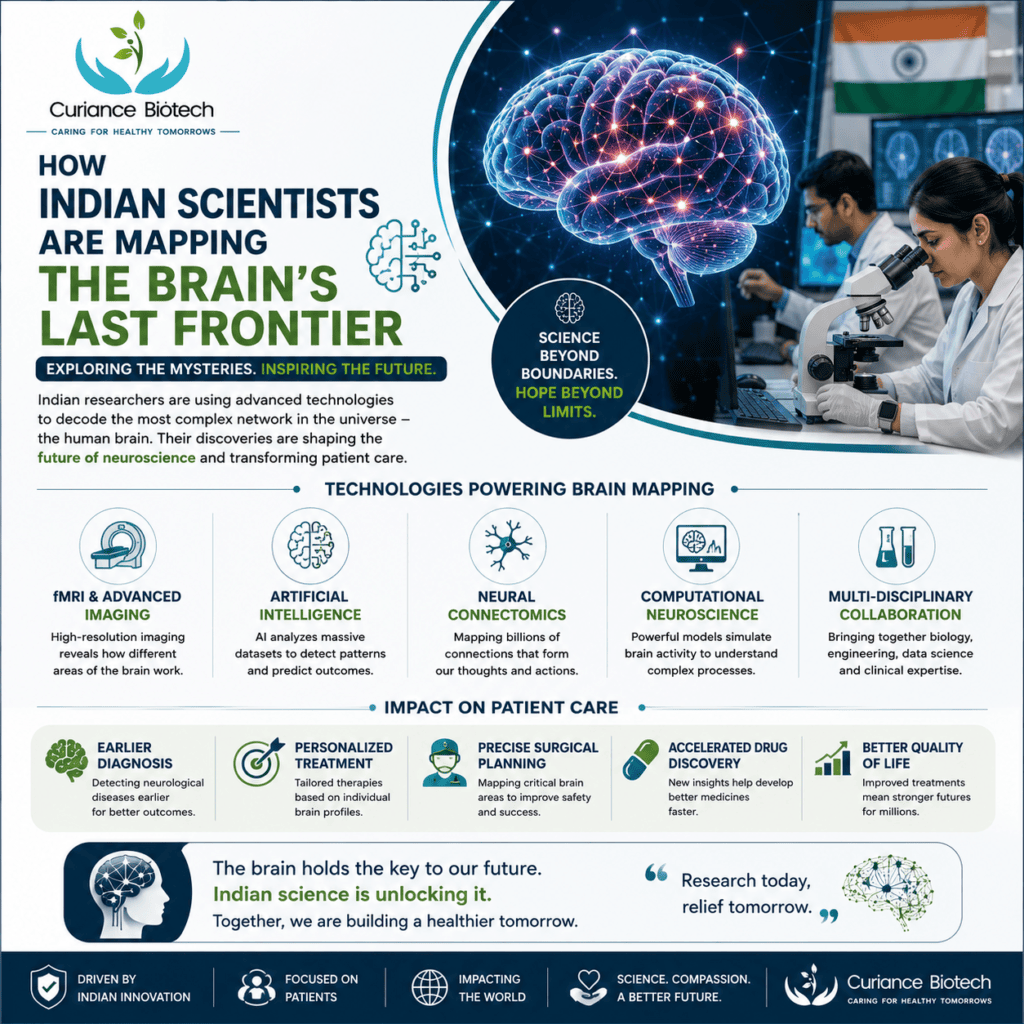
Today, India is emerging as an important contributor to this global scientific effort. Through advanced imaging technologies, artificial intelligence, computational neuroscience, and large-scale research collaborations, Indian scientists are helping map what many researchers describe as the brain’s last frontier.
These discoveries are expected to improve disease diagnosis, accelerate drug development, and bring personalized neurological care closer to reality.
At Curiance Biotech, we believe that sharing advances in biomedical research helps patients, healthcare professionals, and researchers better understand the future of medicine.
What Does Brain Mapping Mean?
Brain mapping is the process of studying how different regions of the brain are organized and connected.
Scientists aim to understand:
- How neurons communicate
- Which brain regions control specific functions
- How memories are stored
- How emotions are processed
- How neurological diseases alter brain activity
Rather than studying individual brain cells, modern brain mapping examines entire neural networks working together.
Why Is Brain Mapping Important?
The brain controls virtually every function in the human body.
Understanding its complex networks could transform the diagnosis and treatment of diseases such as:
- Alzheimer’s disease
- Parkinson’s disease
- Brain tumors
- Stroke
- Epilepsy
- Multiple sclerosis
- Depression
- Autism spectrum disorders
Earlier diagnosis and more targeted therapies may become possible as brain mapping technologies continue to improve.
India’s Growing Role in Neuroscience
India has significantly expanded its neuroscience research capabilities over the past decade.
Researchers from leading institutions are contributing to international efforts by combining expertise in:
- Neurobiology
- Medical imaging
- Artificial intelligence
- Biomedical engineering
- Data science
- Computational neuroscience
These multidisciplinary collaborations are helping scientists better understand how healthy and diseased brains function.
Advanced Technologies Driving Brain Research
Modern brain mapping relies on several cutting-edge technologies.
Functional MRI (fMRI)
Functional magnetic resonance imaging measures changes in blood flow to identify active regions of the brain during different tasks.
This allows researchers to study brain function without surgery.
Artificial Intelligence
AI algorithms can analyze enormous volumes of brain imaging data much faster than traditional methods.
Machine learning is helping researchers:
- Detect subtle disease patterns
- Predict disease progression
- Improve diagnostic accuracy
High-Resolution Brain Imaging
New imaging systems provide unprecedented detail of brain structures and neural pathways.
These advances improve scientists’ understanding of both healthy brain function and disease.
Computational Neuroscience
Powerful computer models simulate neural activity, helping researchers explore how billions of neurons interact.
These simulations provide insights that would be impossible to observe directly.
Potential Impact on Patient Care
Brain mapping research may improve healthcare in several important ways.
Earlier Diagnosis
Many neurological diseases begin years before symptoms appear.
Advanced brain imaging may eventually detect these changes earlier, allowing treatment to begin sooner.
Personalized Treatment
Every patient’s brain is unique.
Future therapies may be tailored to an individual’s specific brain networks rather than using a one-size-fits-all approach.
Better Surgical Planning
Brain mapping already helps neurosurgeons identify critical brain regions before surgery.
This reduces the risk of damaging areas responsible for speech, movement, or memory.
Accelerated Drug Development
Understanding how neurological diseases affect brain networks helps researchers identify new therapeutic targets for future medicines.
Challenges Researchers Continue to Face
Despite remarkable progress, significant challenges remain.
The human brain contains approximately:
- 86 billion neurons
- Hundreds of trillions of neural connections
Managing and interpreting this enormous amount of biological information requires:
- Advanced computing
- International collaboration
- Long-term investment
- Continuous technological innovation
Brain mapping remains one of the greatest scientific challenges of our time.
Collaboration Is Driving Progress
Modern neuroscience is increasingly collaborative.
Indian researchers work alongside scientists worldwide through:
- Academic partnerships
- Government-funded initiatives
- International brain research programs
- Shared scientific databases
These collaborations accelerate discoveries and promote knowledge sharing across borders.
Looking Toward the Future
Experts believe brain mapping will continue transforming medicine over the coming decades.
Future advances may include:
- Earlier diagnosis of neurological diseases
- Precision neurology
- AI-assisted treatment planning
- Improved rehabilitation
- Better understanding of mental health disorders
- More effective therapies for brain tumors
The journey toward fully understanding the human brain is far from complete, but scientific progress continues at an unprecedented pace.
Frequently Asked Questions
What is brain mapping?
Brain mapping is the scientific study of brain structure, function, and neural connections using advanced imaging and computational technologies.
Why is brain mapping important?
It helps researchers better understand neurological diseases, improve diagnosis, and develop more targeted treatments.
How are Indian scientists contributing?
Researchers in India are advancing brain mapping through neuroscience research, artificial intelligence, medical imaging, and international scientific collaborations.
Will brain mapping cure neurological diseases?
Brain mapping alone is not a treatment, but it provides valuable knowledge that supports the development of future therapies and earlier diagnosis.
Final Thoughts
The human brain remains one of science’s greatest mysteries.
As Indian scientists continue contributing to global brain mapping research, their work is expanding our understanding of how the brain functions and how neurological diseases develop.
These discoveries may ultimately lead to earlier diagnoses, more personalized treatments, and improved outcomes for millions of patients worldwide.
At Curiance Biotech, we are committed to sharing credible medical and scientific developments that advance healthcare knowledge and inspire innovation.
Medical Disclaimer
This article is intended for educational purposes only and should not replace professional medical advice. Patients experiencing neurological symptoms should consult a qualified healthcare professional for diagnosis and treatment.


