Introduction
Cancer treatment has evolved dramatically over the past two decades. While chemotherapy remains a cornerstone of cancer care, researchers continue to develop smarter therapies that can attack cancer cells while reducing damage to healthy tissues.
One promising development is RK-251, an experimental “smart” anticancer drug designed to activate primarily inside cancer cells. Although some headlines describe it as a replacement for chemotherapy, the reality is more nuanced: RK-251 is still in the preclinical research stage, and much more testing is required before it could become a standard treatment. citeturn1search0
At CBMeds, a division of Curiance Biotech, we believe it is important to separate exciting scientific discoveries from proven clinical treatments.
What Is RK-251?
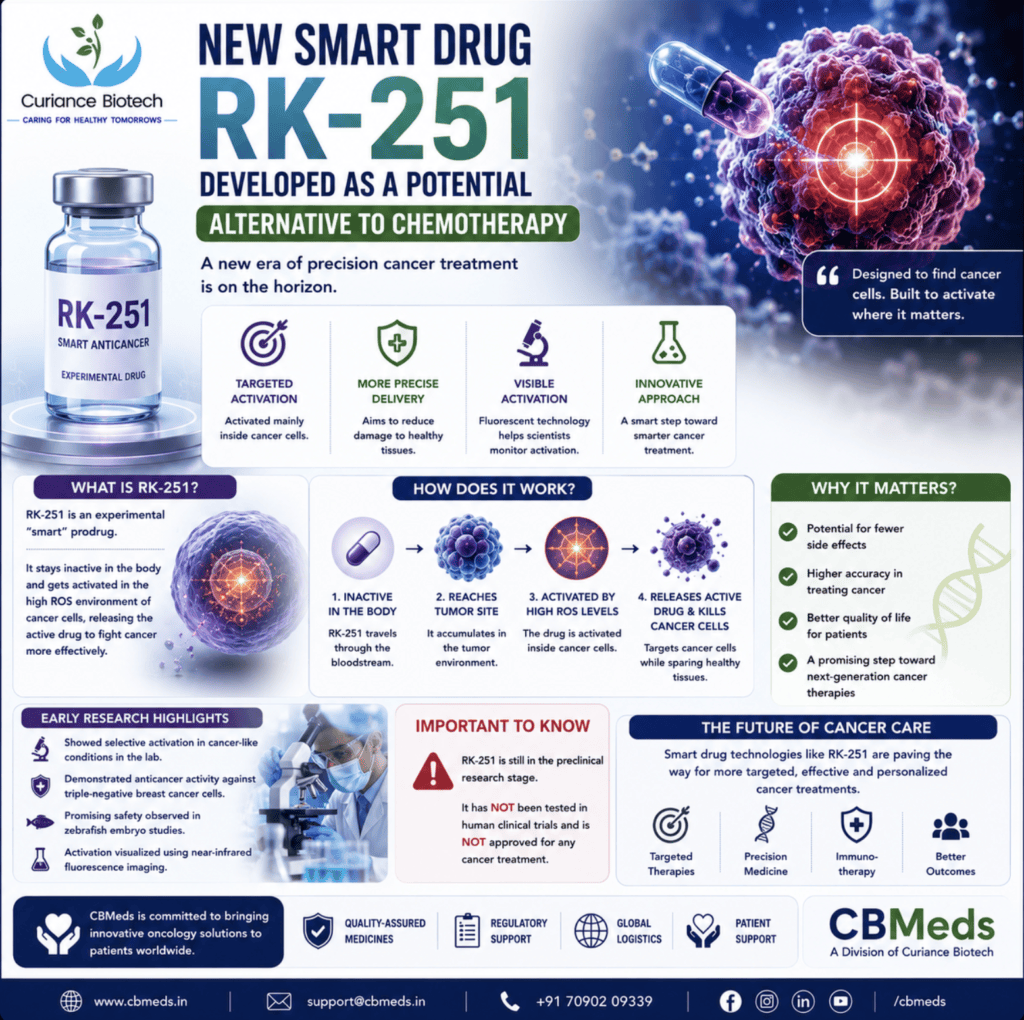
RK-251 is an experimental prodrug, meaning it is designed to remain relatively inactive until it reaches the tumour environment.
Researchers developed RK-251 by linking the anticancer compound NBDHEX to a fluorescent carrier through a reactive oxygen species (ROS)-responsive mechanism. Cancer cells often contain higher levels of ROS than normal cells, allowing the drug to become activated preferentially inside tumours. citeturn1search0
This “smart activation” approach aims to increase treatment precision while limiting exposure of healthy tissues.
How Does RK-251 Work?
RK-251 uses a targeted activation strategy.
Instead of releasing its active drug throughout the body immediately, it is designed to:
- Travel through the bloodstream in an inactive form
- Reach tumour tissue
- Become activated by elevated ROS levels inside cancer cells
- Release the active anticancer compound where it is needed
Researchers also incorporated a near-infrared fluorescent component, allowing activation to be visualised in laboratory studies. citeturn1search0
Why Is It Called a “Smart Drug”?
Unlike conventional chemotherapy, which affects both cancerous and healthy rapidly dividing cells, smart drug systems aim to improve selectivity.
Potential advantages include:
- More targeted drug delivery
- Reduced exposure of healthy tissues
- Better treatment precision
- Lower risk of off-target toxicity
- Ability to monitor drug activation in research settings
These goals are driving significant innovation in oncology drug development. citeturn1academia14
What Have Researchers Found So Far?
In laboratory experiments, RK-251 showed encouraging results:
- Selective activation in cancer-like conditions
- Anticancer activity against triple-negative breast cancer (MDA-MB-231) cells
- Activation confirmed using fluorescence imaging
- Promising safety observations in zebrafish embryo studies
These findings suggest that the technology has potential, but they do not demonstrate effectiveness in humans. citeturn1search0
Is RK-251 a Replacement for Chemotherapy?
Not at this stage.
Although news headlines may describe RK-251 as a chemotherapy replacement, there is currently no clinical evidence showing that it can replace standard chemotherapy in patients.
Before any new medicine becomes part of routine cancer care, it must successfully complete:
- Animal studies
- Phase I clinical trials (safety)
- Phase II trials (effectiveness)
- Phase III trials (comparison with existing treatments)
- Regulatory review and approval
RK-251 has not yet completed these steps. citeturn1search0
Why Smart Drug Delivery Matters
Modern oncology is increasingly focused on delivering medicines more precisely.
Smart drug-delivery systems may help:
- Improve treatment accuracy
- Reduce side effects
- Increase drug concentration inside tumours
- Improve patient quality of life
Researchers worldwide are actively exploring nanoparticles, antibody-drug conjugates, and stimuli-responsive drug systems to achieve these goals. citeturn1academia14
The Future of Cancer Treatment
Cancer care is becoming more personalised through advances such as:
- Targeted therapy
- Immunotherapy
- Precision medicine
- Molecular testing
- Smart drug-delivery technologies
Rather than replacing existing treatments overnight, many new therapies are likely to complement current approaches and provide additional options for carefully selected patients.
Current Proven Treatment Options
Today, cancer treatment may include:
- Surgery
- Chemotherapy
- Radiation therapy
- Immunotherapy
- Hormonal therapy
- Targeted therapy
The most appropriate treatment depends on:
- Cancer type
- Stage
- Molecular profile
- Overall health
- Patient preferences
Treatment decisions should always be made with a qualified oncologist.
How CBMeds Supports Patients
CBMeds, a division of Curiance Biotech, supports healthcare professionals, hospitals, and eligible patients by facilitating responsible international access to prescribed oncology medicines.
Our services include:
- Quality-assured oncology medicines
- Regulatory documentation support
- International logistics assistance
- Patient support
- Healthcare professional coordination
- Global access across 175+ countries
We remain committed to improving access to evidence-based cancer treatments while supporting ongoing innovation in oncology.
Frequently Asked Questions
Is RK-251 approved for cancer treatment?
No. RK-251 is currently an experimental drug under preclinical investigation and has not been approved for routine clinical use. citeturn1search0
Can RK-251 replace chemotherapy today?
No. Current evidence is limited to laboratory and early preclinical research. More studies and human clinical trials are needed before it could be considered an alternative to standard chemotherapy. citeturn1search0
What makes RK-251 different?
RK-251 is designed as a ROS-responsive prodrug that becomes activated primarily within cancer cells, potentially improving treatment precision. citeturn1search0
Why are smart drugs important?
Smart drug technologies aim to deliver treatment more selectively, reducing unnecessary exposure of healthy tissues while improving therapeutic effectiveness.
Final Thoughts
RK-251 represents an exciting step forward in cancer drug research. Its innovative design demonstrates how scientists are working toward therapies that can target cancer more precisely while minimising harm to healthy tissues.
However, it is important to remember that RK-251 is still an experimental therapy. Although the early laboratory findings are promising, it cannot yet be considered a replacement for chemotherapy until rigorous clinical trials confirm its safety and effectiveness.
At CBMeds, a division of Curiance Biotech, we remain committed to sharing accurate, evidence-based information about the latest advances in oncology while supporting responsible access to approved cancer treatments worldwide.
About CBMeds
CBMeds, a division of Curiance Biotech, facilitates responsible international access to quality-assured oncology medicines. Supporting patients, hospitals, and healthcare professionals in 175+ countries, CBMeds is committed to improving access to prescribed cancer treatments through trusted logistics, regulatory compliance, and patient-centred support.
Medical Disclaimer
This article is intended for educational purposes only and should not replace professional medical advice. Experimental medicines discussed here are not approved treatments unless authorised by relevant regulatory agencies. Always consult a qualified oncologist regarding diagnosis and treatment options.


