
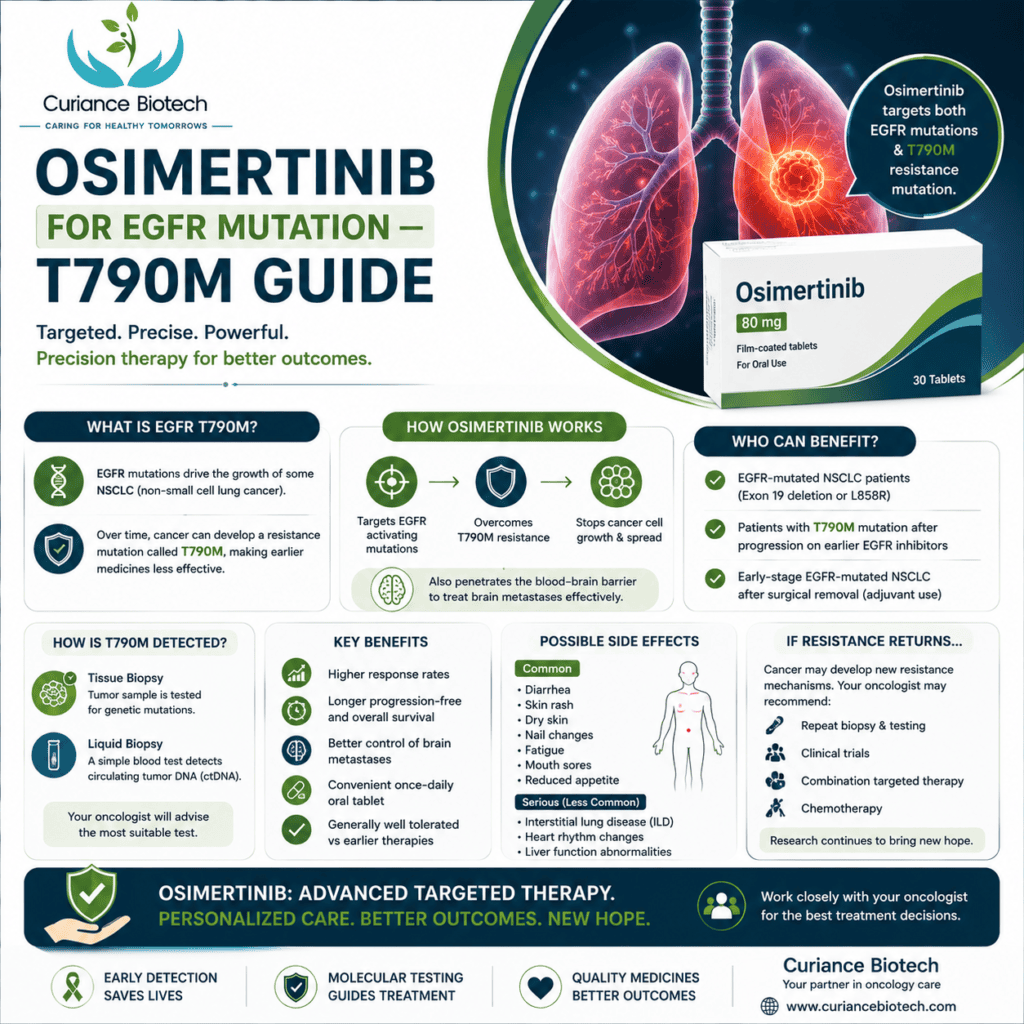
Introduction
For many patients with EGFR-mutated non-small cell lung cancer (NSCLC), targeted therapy has transformed treatment outcomes. Earlier EGFR inhibitors helped many patients control their cancer for months or even years. However, over time, some cancers develop resistance, making these medicines less effective.
One of the most common resistance mechanisms is the EGFR T790M mutation.
This is where Osimertinib has become a major breakthrough. Specifically designed to target both the original EGFR mutation and the T790M resistance mutation, Osimertinib has significantly improved treatment outcomes for many patients.
At Curiance Biotech, we believe patients should understand why genetic testing matters and how precision medicine is changing lung cancer treatment.
What Is an EGFR Mutation?
The Epidermal Growth Factor Receptor (EGFR) is a protein found on the surface of many cells. It helps regulate normal cell growth and division.
In some lung cancers, changes (mutations) occur in the EGFR gene, causing cancer cells to grow uncontrollably.
The two most common activating EGFR mutations are:
- Exon 19 deletion
- Exon 21 L858R mutation
These mutations are commonly found in patients with:
- Non-small cell lung cancer (NSCLC)
- Never-smokers
- Light smokers
- Asian populations
- Women (slightly more common)
Patients with these mutations often respond well to EGFR-targeted therapies.
EGFR Positive Lung Cancer — A Complete Guide for Patients and Families
What Is the T790M Mutation?
Although many patients initially respond well to first- or second-generation EGFR inhibitors, the cancer may eventually become resistant.
In approximately 50–60% of these cases, resistance develops because of a new mutation called T790M.
The T790M mutation changes the EGFR protein in a way that prevents earlier EGFR medicines from binding effectively, allowing cancer cells to continue growing.
This is known as acquired resistance.
Why Was Osimertinib Developed?
Osimertinib is a third-generation EGFR tyrosine kinase inhibitor (TKI).
Unlike earlier EGFR inhibitors, it was specifically designed to:
- Target common EGFR activating mutations.
- Target the T790M resistance mutation.
- Minimize effects on normal EGFR found in healthy tissues.
- Penetrate the blood-brain barrier more effectively.
This makes Osimertinib particularly valuable for patients whose cancer has developed T790M-mediated resistance.
How Does Osimertinib Work?
Osimertinib blocks abnormal EGFR signaling inside cancer cells.
By inhibiting the mutated receptor, it helps:
- Slow cancer growth.
- Reduce tumor size.
- Delay disease progression.
- Improve progression-free survival.
- Control brain metastases more effectively than many earlier therapies.
Who Should Receive Osimertinib?
Today, Osimertinib is widely used for several EGFR-mutated NSCLC indications.
These include:
First-Line Treatment
Patients with:
- EGFR Exon 19 deletion
- EGFR Exon 21 L858R mutation
may receive Osimertinib as initial treatment.
This recommendation was established through the FLAURA trial, which demonstrated improved survival compared with earlier EGFR inhibitors.
T790M-Positive Disease After Earlier EGFR Therapy
Patients whose cancer progresses after treatment with earlier EGFR inhibitors should undergo repeat molecular testing.
If the T790M mutation is detected, Osimertinib is often the preferred treatment option.
Adjuvant Therapy
Following complete surgical removal of certain early-stage EGFR-mutated lung cancers, Osimertinib may also be prescribed to reduce the risk of recurrence.
How Is T790M Detected?
Testing is essential before making treatment decisions.
Your oncologist may recommend:
Tissue Biopsy
A small sample of the tumor is analyzed for genetic mutations.
Liquid Biopsy
A blood test detects circulating tumor DNA (ctDNA).
Liquid biopsy is less invasive and can often identify the T790M mutation without another tissue procedure.
Sometimes both tests may be required.
Benefits of Osimertinib
Clinical research has shown several important advantages.
These include:
- Higher response rates
- Longer progression-free survival
- Improved overall survival
- Better control of brain metastases
- Convenient once-daily oral tablet
- Generally better tolerability than chemotherapy
Can Osimertinib Treat Brain Metastases?
Yes.
One of Osimertinib’s most important advantages is its ability to cross the blood-brain barrier.
This allows the medicine to reach tumors inside the brain more effectively than earlier EGFR inhibitors.
Patients with brain metastases often experience better central nervous system (CNS) disease control.
Possible Side Effects
Most patients tolerate Osimertinib well.
Common side effects include:
- Diarrhea
- Skin rash
- Dry skin
- Nail changes
- Fatigue
- Mouth sores
- Reduced appetite
Less common but serious side effects include:
- Interstitial lung disease (ILD)
- Heart rhythm changes
- Liver function abnormalities
Your oncology team will monitor treatment closely with blood tests and regular follow-up.
What Happens If Resistance Develops Again?
Even Osimertinib may eventually stop working in some patients.
Common resistance mechanisms include:
- C797S mutation
- MET amplification
- HER2 alterations
- Small-cell transformation
When progression occurs, your oncologist may recommend:
- Repeat biopsy
- Molecular testing
- Clinical trial participation
- Chemotherapy
- Combination targeted therapy
Research continues to develop next-generation treatments.
Frequently Asked Questions
Does every patient develop the T790M mutation?
No.
Approximately half of patients who become resistant to earlier EGFR inhibitors develop T790M.
Can Osimertinib be used without T790M?
Yes.
Today, Osimertinib is also the preferred first-line treatment for many newly diagnosed EGFR-mutated NSCLC patients.
Is genetic testing necessary?
Absolutely.
Treatment decisions depend on identifying the specific EGFR mutation.
Precision medicine begins with molecular testing.
Is Osimertinib chemotherapy?
No.
Osimertinib is a targeted therapy.
It works differently from chemotherapy by specifically targeting cancer cells carrying EGFR mutations.
Can Osimertinib cure lung cancer?
For metastatic disease, Osimertinib is designed to control cancer rather than cure it.
However, many patients experience prolonged disease control and improved quality of life.
Accessing Osimertinib Through Curiance Biotech
If your oncologist has prescribed Osimertinib, Curiance Biotech helps patients access high-quality oncology medicines through the Named Patient Medicine framework.
We support patients and healthcare professionals by providing:
- Genuine quality-assured medicines
- Regulatory guidance
- International documentation support
- Worldwide shipping
- Responsive customer assistance
Our experienced team helps simplify the medicine access process while maintaining full regulatory compliance.
Final Thoughts
The discovery of the T790M mutation changed the way oncologists understand resistance in EGFR-mutated lung cancer.
Osimertinib has become one of the most important advances in precision oncology by specifically targeting this resistance mechanism while also improving outcomes for newly diagnosed patients.
As molecular testing continues to evolve, personalized treatment decisions are helping patients receive therapies that are better matched to the biology of their cancer.
At Curiance Biotech, we remain committed to improving access to life-saving oncology medicines while supporting patients and healthcare professionals through reliable educational resources.
Medical Disclaimer
This article is intended for educational purposes only and should not replace professional medical advice. Always consult a qualified oncologist regarding diagnosis, genetic testing, and treatment decisions.


